Ultimate RoguePlay

Updates

Every release of Ultimate Rogue, newest first. Follow along with the feed.

Water and lava that flow, down through the layers and over the edge

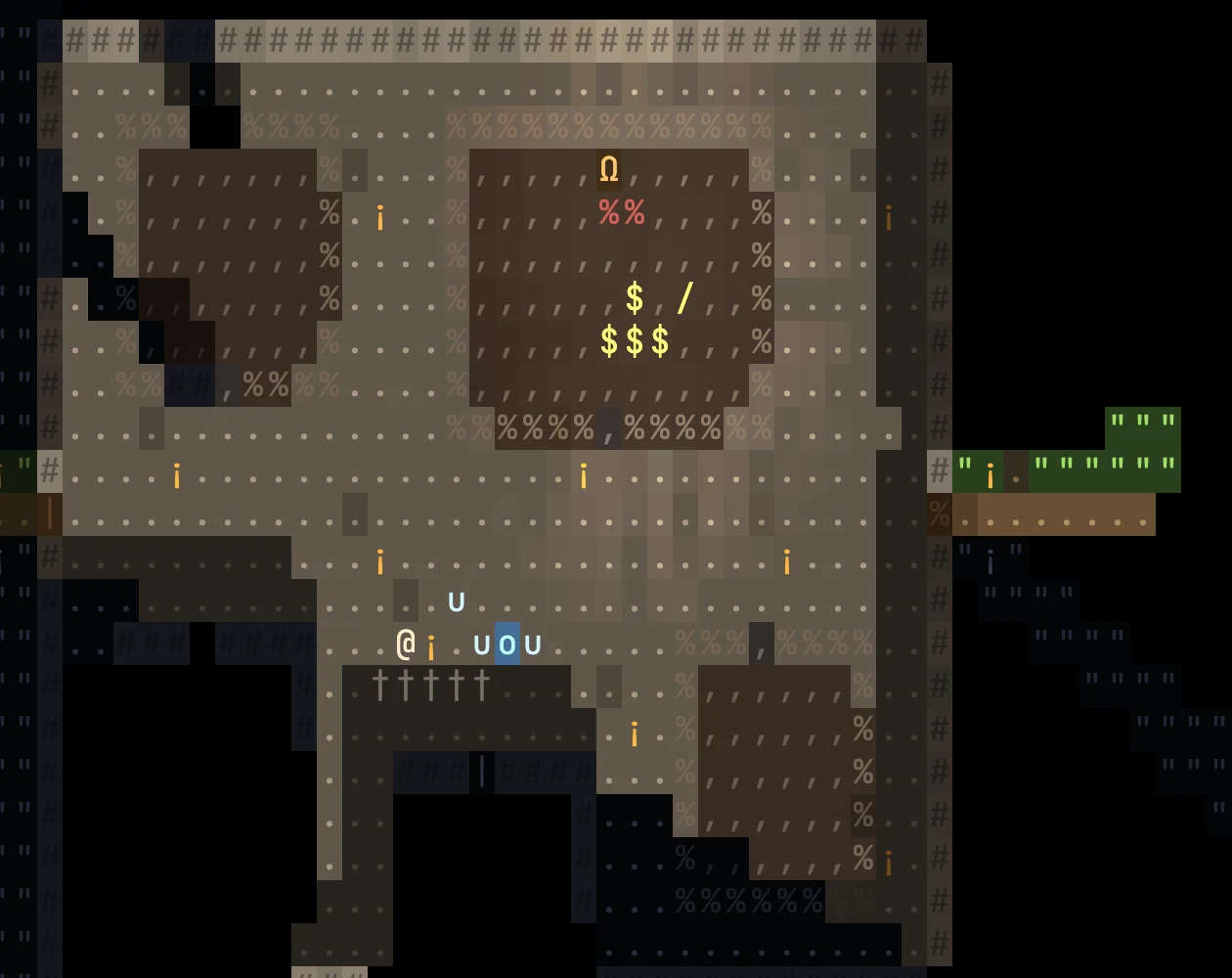
Liquid runs now. Pour a lake out of a storage ring at the top of a shaft and it goes down, layer by layer, and fills the room at the bottom. Dig beside a pool and it drains into your hole. Flood an ant nest and the ants drown. Lava creeps, burns what it touches, and turns to black glass where it meets water.

  • Every cell holds up to seven units of a liquid, and its glyph and colour show how deep: shallows, water over your head, deep water.
  • One rule moves it all: down through any floor that lets it (a hole, stairs, a grate), then out toward level, then still. A grate lets water through; glass holds a pool over a room, until it breaks.
  • Pools, rivers and lakes sit in their beds until you disturb them. Dig beside one and it runs into your hole; take it into a ring and its bed is left dry. A spring fills itself again.
  • Water over a creature's head drowns it if it breathes and can't swim, after a breath or two, and you're told. People, wolves, dogs and bears swim; ants don't. Creatures make for dry ground when it rises round them, and nothing walks into water over its head it can't swim, or into lava.
  • Lava moves every few turns, glows, burns through a wooden floor and comes down after it, and kills what it touches unless it resists fire. Where it meets water it sets as black glass in a burst of steam. It lies in the deepest caves.
  • A ring or bag holds the very units it took in, and pours them back out to flow. Holding lava hurts it every turn, less the higher its grade, until it burns through.
  • Liquid runs off the edge of a map into the next stretch of country, above ground or below, and arrives there when you next go.
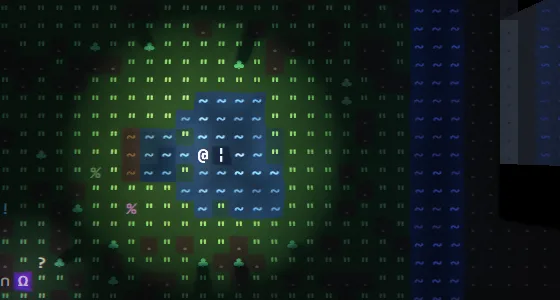
Dusk on the grass: a lake poured out of a storage ring around the dark mouth of a shaft, running down it, beside the muddy bed it was taken from.

Sunlight down a hole, and what you see through one

Light and sight cross between floors along straight lines now, through openings only. The sun through a hole lands at its angle and moves across the floor below through the day, and anything that can see you through an opening, you can see there too.

  • The sun through a hole or a grate lands where its angle takes it: north of the hole at noon, to the west in the morning, to the east after noon. It's bright daylight, and the cellar around it is lit by what the floor gives back.
  • A torch held beside a hole lights the floor below on the far side; a torch below a hole lights whoever stands around its rim.
  • Dug floors are the colour of dry earth and stone now, so daylight on them looks like daylight.
  • You see creatures on the floor above or below through holes, stairwells and grates, drawn at the opening: warmer when above you, cooler when below. Looking at one says where it is: "on the floor above, through the hole".
  • Whatever sees you through an opening, you see too. A creature coming down stairs or dropping through a floor shows at the opening, and gets no blow in until you've had a turn.
  • Sounds from another floor say so: "You hear paws padding below you."
  • The street seen from an upstairs window, or a cellar seen through a grate, is drawn only a little darker than it would be up close, not three times darker.
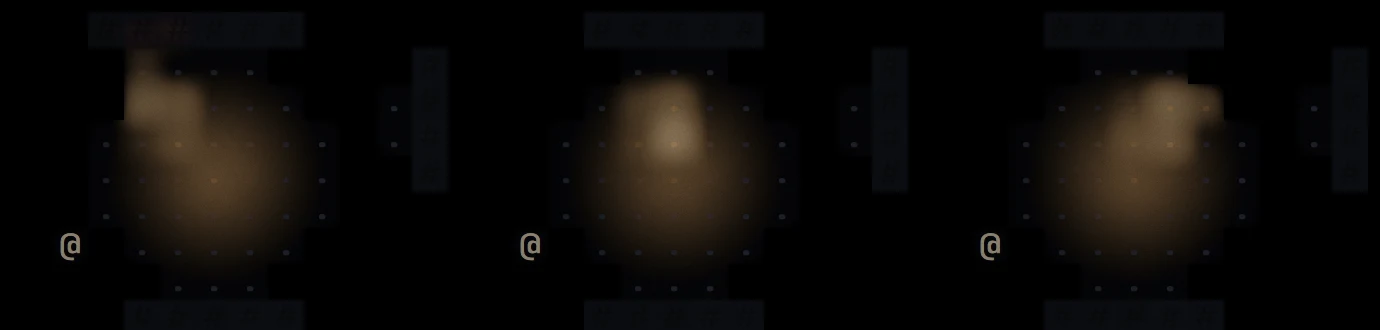
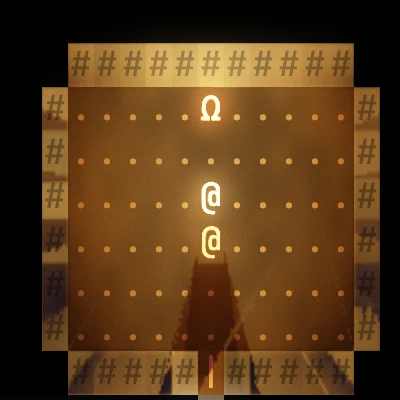
A dug cellar under a one-cell hole, three times on one day: the patch of sunlight on the floor sits to the north-west in the morning, to the north at noon and to the north-east in the afternoon, with a soft glow spreading around it.

Tunnels that run on under the next stretch of country

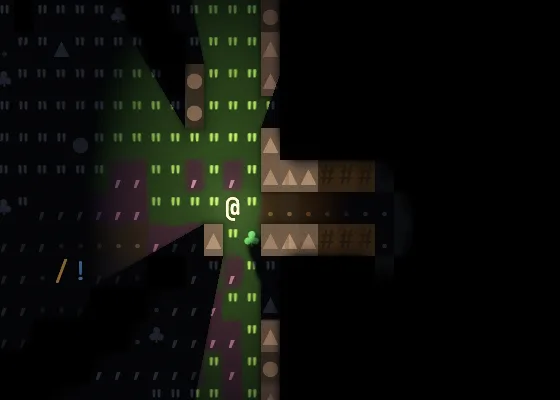
The edge of a map underground isn't the end of the world any more. Dig to it, and your tunnel runs on into the next stretch of country at the same depth, where you can walk on through.

  • Underground, the rock at a map's edge digs like any other when there's country beyond it. Walk off the edge and you come out under the next stretch, as deep below its ground as you were below yours: "The passage runs on under" it.
  • The tunnel goes through: the rock on the far side is dug out to meet it, and an open cave there is left as it is. You never come out inside rock.
  • Toward the sea or high mountains, or off the edge of the map of Eord, the edge stays a wall.
  • Depth is counted from each place's ground, so the town's cellars meet the first layer under the fields beside it.
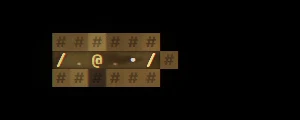
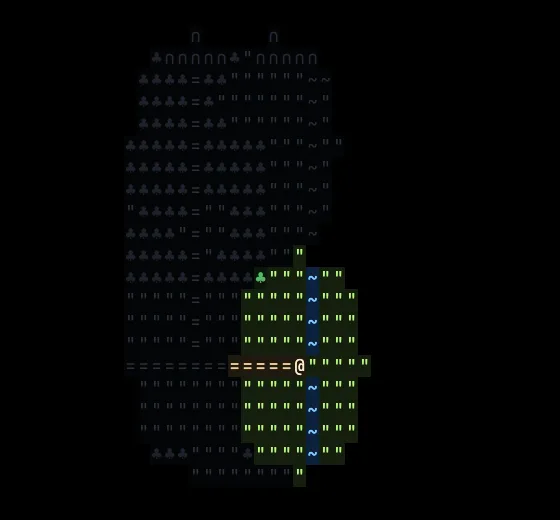
Three layers underground, a short torchlit tunnel dug east through chalk from the very edge of a map, where the passage came through from the next stretch of country.

Floors and storeys: steps both ways, grates, and an upstairs

Every layer is one storey now, with a floor between it and the one below. Floors say what gets through them: a grate lets light, sound and water down but not you, glass lets light and sight through, ice cracks under anything heavy. The town has an inn upstairs, a loft over the shop and cellars under the inn.

  • D then > cuts steps down through your floor, digging out the rock below; you stay at the top and take them as any stairs. D then < cuts steps up through the ceiling: into rock, into the room above, or out into the open air from a cellar or a pit.
  • A hole to drop through is its own key now: D then . (or 5).
  • The D prompt says what each way breaks into: "into rock", "through the floor into a dark room below", "through the ceiling into open air".
  • Stepping onto a floor with open space under it, you hear it sound hollow, and the look panel says so.
  • Stairs down are openings: from above they show the darker storey below, with their steps drawn over it, and what stands at their foot shows through. What stands at their head shows from below.
  • A grate in the street east of the inn looks down into its cellar. Glass floors, ice that cracks and then gives way, and rotten planks are content too.
  • A floor laid over open space has to be held up. Too wide a span and it falls into the room below, with whoever and whatever stood on it.
  • B lays a plank floor, flagstones or a timber grating over a gap, if a wall or a pillar below is near enough to hold it, and takes a floor back up again.
  • The town has storeys: the inn's upstairs, the trader's loft, roofs over the houses, and cellars under the inn. The sky still lights the streets through the open air over them.
  • What you see below is darker by the storeys of air between: the street a storey under a window only a little, a pit three deep much more.
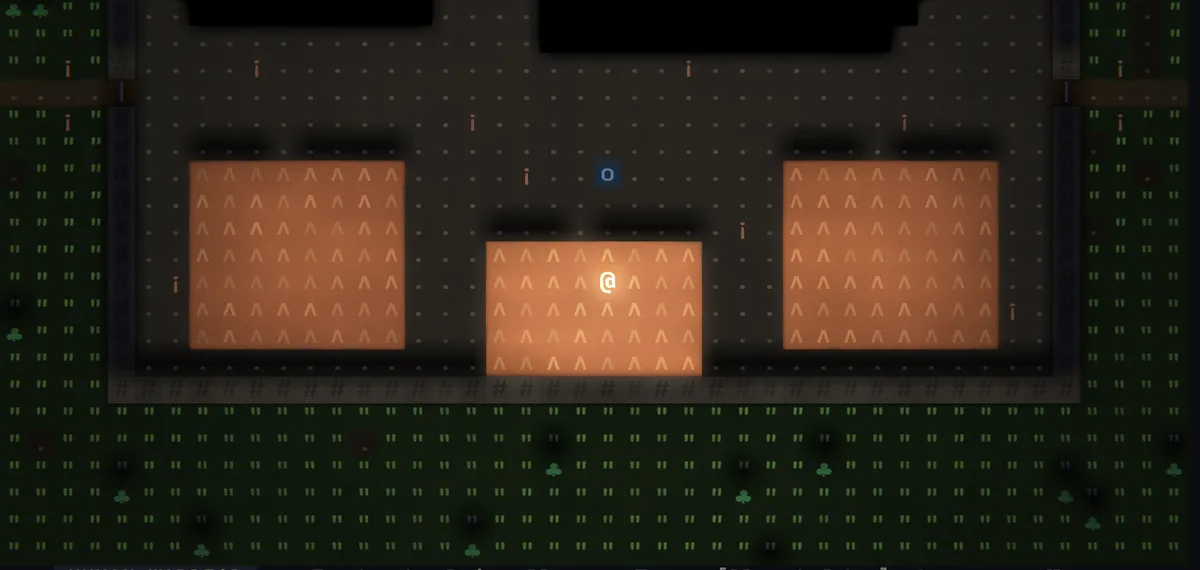
Noon, standing on a roof in the town: the roofs of three houses, shingled and sunlit, on the upper storey, and the streets, the well and the grass a storey below, darker by the air between.

Flint and steel: making things, in the world

Flint does something now. Knap it with any stone into arrowheads, a blade or a scraper; strike it on a steel to light dry grass, a campfire or your own torch. Walk into a forge, a smelter, a workbench or a campfire for one list of what you know how to make there. How good you are shows in how fast the work goes and in the names of what you make.

  • Shift+A uses one thing on another: pick what to use (a stone, a steel, a blade, a flint nodule), then one list of what it can do with what is at hand. Striking a light then asks which way, and the cells that would catch are marked.
  • Walking into a station lists what you know it makes, each with its turns and the grade it will likely come out, or, greyed, exactly what you are missing.
  • Skills for each craft (knapping, firemaking, fletching, carpentry, masonry, smithing, cooking) and for trade and swordwork, from 0 to 100. Skill shortens the work and raises its grade: crude, plain, fine, masterwork, in the name and in the numbers. Every piece you make teaches you a little, and the log says when you get better.
  • Your background teaches you things: the caravan's survivor knows trade and fire-making and carries a flint and steel; the exile knows the sword; the hunter knaps, fletches and makes fire.
  • The town has a smithy now, with a forge, a smelter and a smith who will teach you to smelt and forge, for gold. The carpenter teaches fletching for a few lengths of timber, and the innkeeper a turnip stew. Books from the trader teach too, if you can read them.
  • Smelt ore into bars and forge picks, knives, hatchets, shovels and arrowheads. Iron makes a better pick than copper.
  • Flint darts work with the throw you already have, and hurt more than a stone. Arrows can be fletched and stack, but wait for bows.
  • B builds a campfire and a workbench too, and draws on anything lying beside you. With no flame near, your torch lights from flint and steel, in a turn or two, and sometimes not at first.
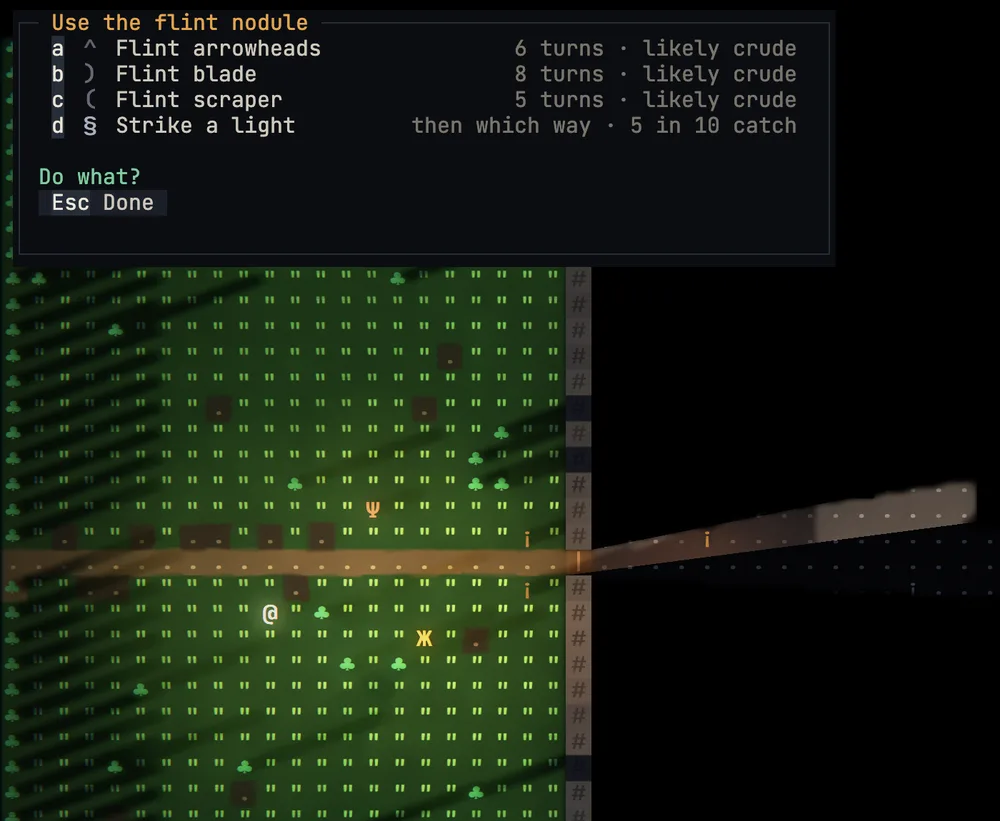
Outside the town gate at dusk: a panel lists what a flint nodule can do here, arrowheads, a blade and a scraper with their turns and likely grades, and striking a light, five times in ten.

Your pack is a thing on your back

What you carry is in a pack you wear. Take it off and it sits on the ground with everything in it; a wolf has none, so it carries nothing.

  • Everyone who carries things wears a pack on their back. The pack and what is in it are your load; the pack itself weighs a little.
  • Take the pack off and it is set down where you stand, with everything still in it. Without one you can only take up what goes straight onto you: the pack itself, or a sword into a free hand.
  • When a creature dies its pack falls with it, still full.
  • Changing shape drops your pack with the rest of your gear, unless the pack is enchanted to resize, in which case it reshapes onto your new back.
  • Ghosts and golems no longer carry packs: they leave what they leave, grave salt or an iron heart, where they fall.
  • Saves from before carry over: what you carried is in a pack on your back.
The pack tab: worn things listed along the top, the pack on the back among them, and the grid of what the pack holds.

Hands full: torches, ten fingers, and bites that need mouths

A torch takes a hand now, so sword, shield and torch no longer fit in two. You have ten fingers, each a place for a ring. Every creature has a body, and it strikes with its parts: a bite needs a mouth. Things are made for a size, and only the rare ones enchanted to resize fit everyone.

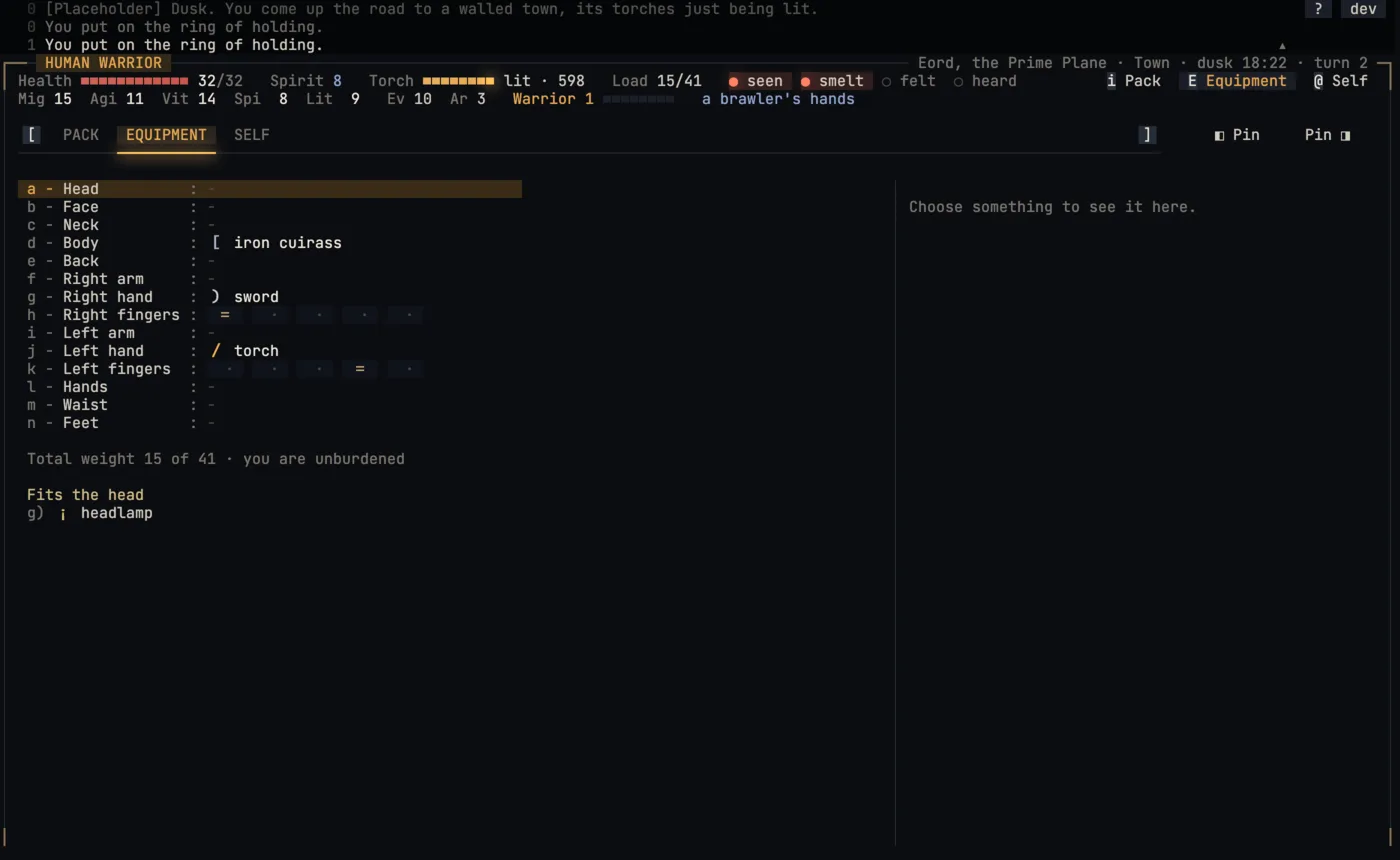
  • A torch is held in a hand like anything else. You arrive at dusk with a lit torch in your off hand; a shield waits in your pack until you choose it over the light. A headlamp, worn on the head, keeps both hands free.
  • Your fingers are on the equipment list, a hand's five on one line, and each can hold a ring. A grown arm brings a hand and five more.
  • Every creature has a body, ghosts and golems and swarms included, and strikes with its parts: a wolf bites with its jaws, you punch with a free hand. With both hands full and no weapon, you have nothing free to strike with, and the game says so.
  • Bodies come in sizes, and things are made for one. A troll can't use your sword, and the game tells you when something is made for a larger or smaller body.
  • A rare enchantment lets a thing resize to whoever wears it, gaining or shedding weight into a hidden store, within limits. The ring of holding has it.
  • Changing shape drops what you wear and hold where you stand. Only a thing with the resizing enchantment reshapes to fit you, so the ring of holding becomes a fox's collar, and goes back on your finger when you return.
  • Saves from before carry over: your light goes into a free hand, and your rings onto your ring fingers.
The equipment list: a sword in the right hand, a torch in the left, and each hand's five fingers on a line of their own, with a ring on the right thumb and another on the left ring finger.

Panels beside the map, and a mind that shows through

Pin your pack, your equipment or yourself beside the map and keep them in view. The screen is your mind's own awareness, so what happens to your mind happens to it: colour goes with colour vision, letters fade when your spirit runs low, and they swim when your qi turns.

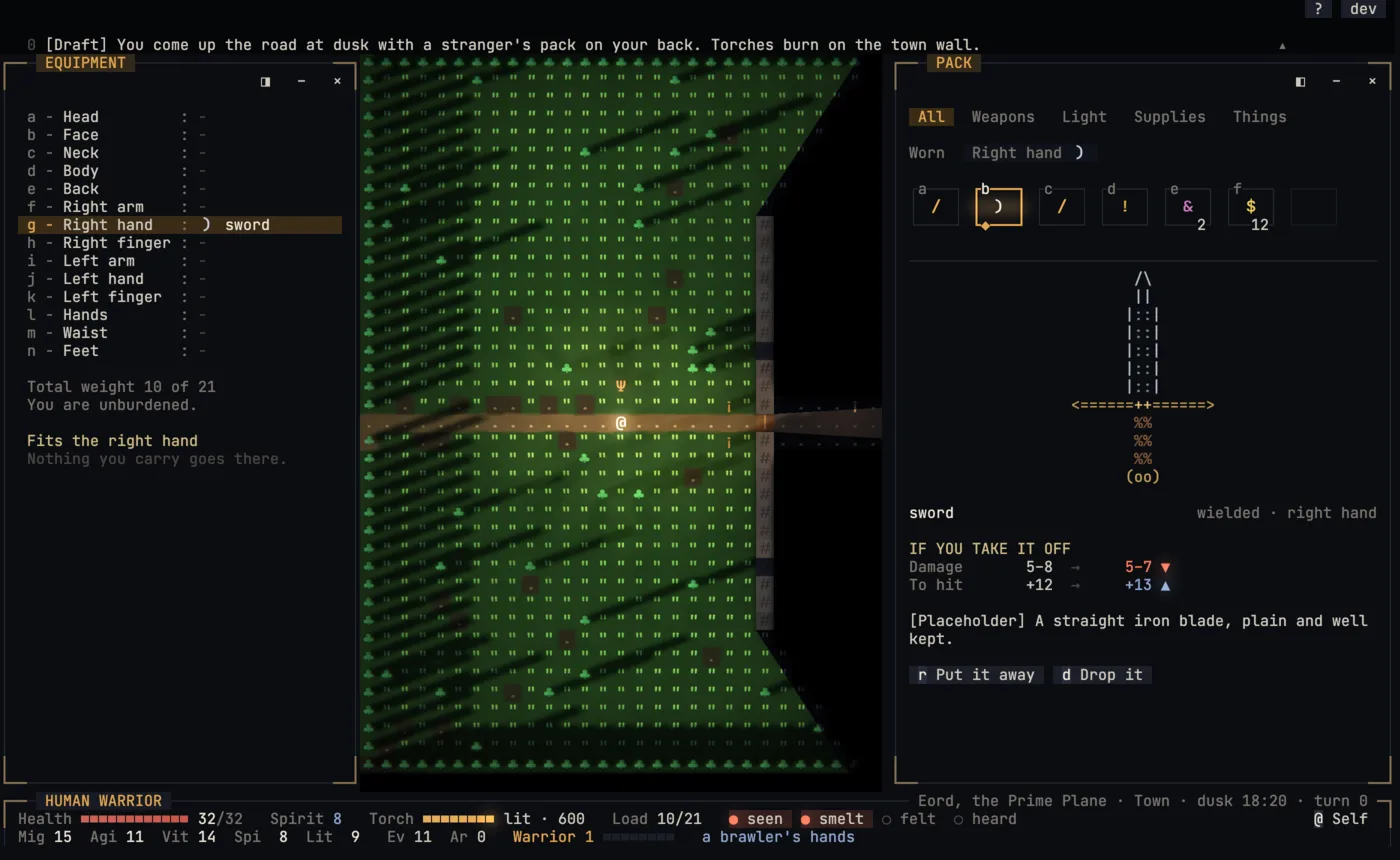
  • Pin any of the card's tabs to the left or right of the map with the Pin buttons beside its tabs. A pinned panel stays in view; drag its edge to make it wider or narrower, fold it to a strip, move it to the other side, or send it back into the card.
  • Drag the little handle at the right of the messages to show between one and twelve rows of them, or click it to fold them to one. The screen remembers how you left it.
  • In a body without colour vision, a wolf's, the whole screen loses its reds and greens, the way the world does.
  • When your spirit runs low the screen's letters fade. When your qi turns, a slow wave passes over them and letters swim into the world's own script.
  • Going to sleep closes your eyes: the screen darkens from the corners in, stays dark through the night, and opens slowly on the morning.
  • Things can have portraits of their own now. The sword's is put together from parts (blade, guard, grip and pommel), ready for crafting to swap them.
  • @ opens yourself again: on most keyboards it was read as a shove.
The map between two pinned panels: equipment on the left with the sword in the right hand, and the pack on the right showing the sword's portrait, a blade, cross-guard, grip and pommel.

Creatures of the deep, soft rock, and light down a hole

Dig a hole to the sky and daylight pours down it onto the floor below. Chalk and sandstone lie between the clay and the stone. The deep has creatures of its own now, from glowing crickets to things you would rather not wake. And the town shouts at you the moment it sees you at its wall.

  • Light falls down through holes. Daylight down a shaft lays a pool on the floor below, brightest straight under it and fading across the room; a torch beside the hole throws its warm light down, the moon its cold. The deeper the shaft, the less gets down.
  • Chalk, sandstone and mudstone lie under the clay and above the stone. A pick gets through them quickly, a shovel slowly. Chalk gives up the odd flint, and a hammer squares sandstone blocks into building stone.
  • Below the first few layers the deep keeps its own creatures: blind hounds that come to the ring of a pick, pale things that hunt in packs, grubs that eat through rock, something huge and slow at the bottom, and drifts of glowing crickets that scatter as you come. Natural caverns have something living in them from the start.
  • Anyone in town who sees you digging at the wall or a house shouts at once, and that stops you. They remember it. Carry on if you dare.
  • A mason's hammer breaks down doors and the town gate, a little slower than an axe.
A small dug room underground, lit only by daylight falling through a shaft in its ceiling: a warm pool on the floor, a stone casting a short shadow, the walls faintly lit.

Smoother steps, and a quicker screen

When you step, the view slides along with you, and you no longer jump back a little as a step begins. The screen also does far less work: as you walk it lights again only what moves, and it keeps what it has already worked out.

  • When the view follows you, it slides with your step instead of jumping a tile, so you stay still on screen while the world moves past.
  • A step no longer starts by drawing you a little behind where you stood.
  • As you walk, only the light around what moves is worked out again. Standing still beside a fire or a portal, none of it is.
  • Lines of sight through mirrors and past walls are shared between neighbouring points of the screen, so a room of mirrors draws in about two thirds of the time it took.
  • On fast screens, catching up the places beside you while you stand idle now fits inside a frame instead of stalling one.
  • Smoke no longer slows the whole screen: only the lines of sight that pass near it look for it, and a field burning beside you draws in under half the time it took.
  • The dark you know nothing of costs the screen nothing now: where nothing is seen or remembered, it no longer works out what would be there. Every place draws in a fifth to a half less time.

Bodies made of parts, and a menu under the right button

Every body is made of its own parts now: a head, a face, arms with hands and fingers, a tail on a wolf. What you wear goes on the part it fits, and a mutation can grow new parts or take them away. A right click on anything shows what you can do with it.

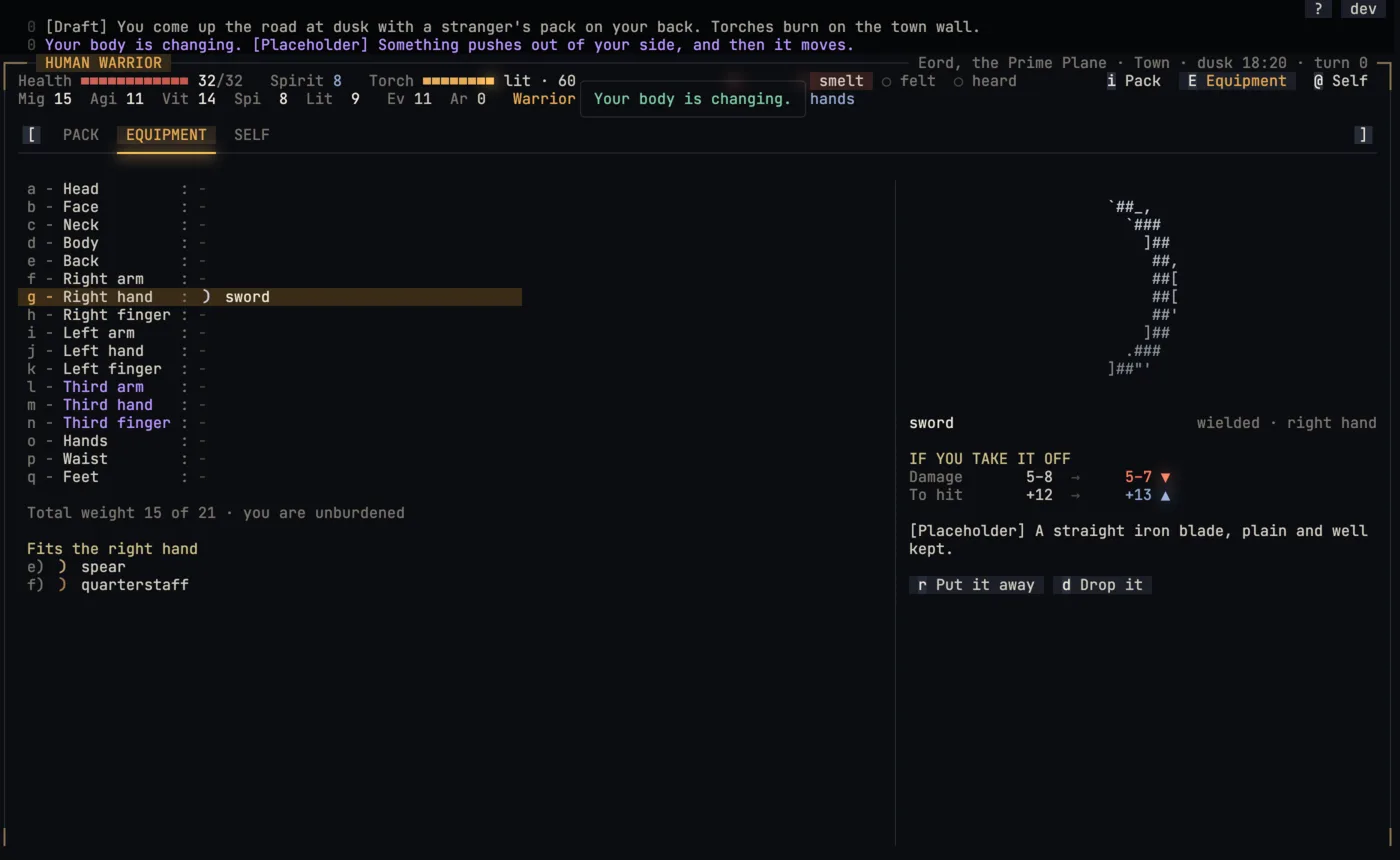
  • Equipment lists your body part by part, head to feet: head, face, neck, body, back, each arm, hand and finger, hands, waist and feet. Choose a part to see what you carry that fits it, then click one to put it there, or drag it onto any part it fits.
  • Drag a ring from one finger to the other, or a held thing back down to put it in your pack.
  • A shield goes in the hand you don't fight with. A two-handed weapon takes up both hands, and putting something in the other hand puts the weapon away.
  • An extra arm grows a whole arm, with a hand and a finger, beside the other two, and it can hold things of its own. Grown parts show in the colour of change, and they go when the mutation does, dropping what they held into your pack.
  • Animals have bodies too. Possess a wolf and its list is a wolf's: no hands, so no weapon arts and no digging with bare paws.
  • Equipment opens with E. Every lowercase letter already moves you or does something, so e never opened it, whatever the screen said.
  • Right-click a creature, a thing or a place for a menu of what you can do there. A left click attacks a foe and talks to anyone neutral; to strike someone neutral, choose Attack from the menu.
  • Saves from before carry over: what you wore and held is on the matching parts.
The equipment list: the body's parts from head to feet, a sword in the right hand, and a third arm, hand and finger in violet where a mutation grew them.

A new screen, and everything about you in one card

Every cell on screen is one size now, messages run along the top, and the side panel is gone. Along the bottom sits the top of a card with how you are; open it and it slides up over the map with your pack, your equipment and yourself.

  • The map is drawn in square tiles, and words sit in half tiles, two letters to a tile. Zoom (+ and −) scales the whole screen at once, and the things you carry show as the same tiles the map draws.
  • Messages run along the top of the screen, writing themselves in as they arrive. Click them to see the whole log.
  • Along the bottom are your health, spirit, torch, load, who can find you, your attributes and your class. Press i, e or @, click the edge above them, or drag it up, and the card slides up over the map.
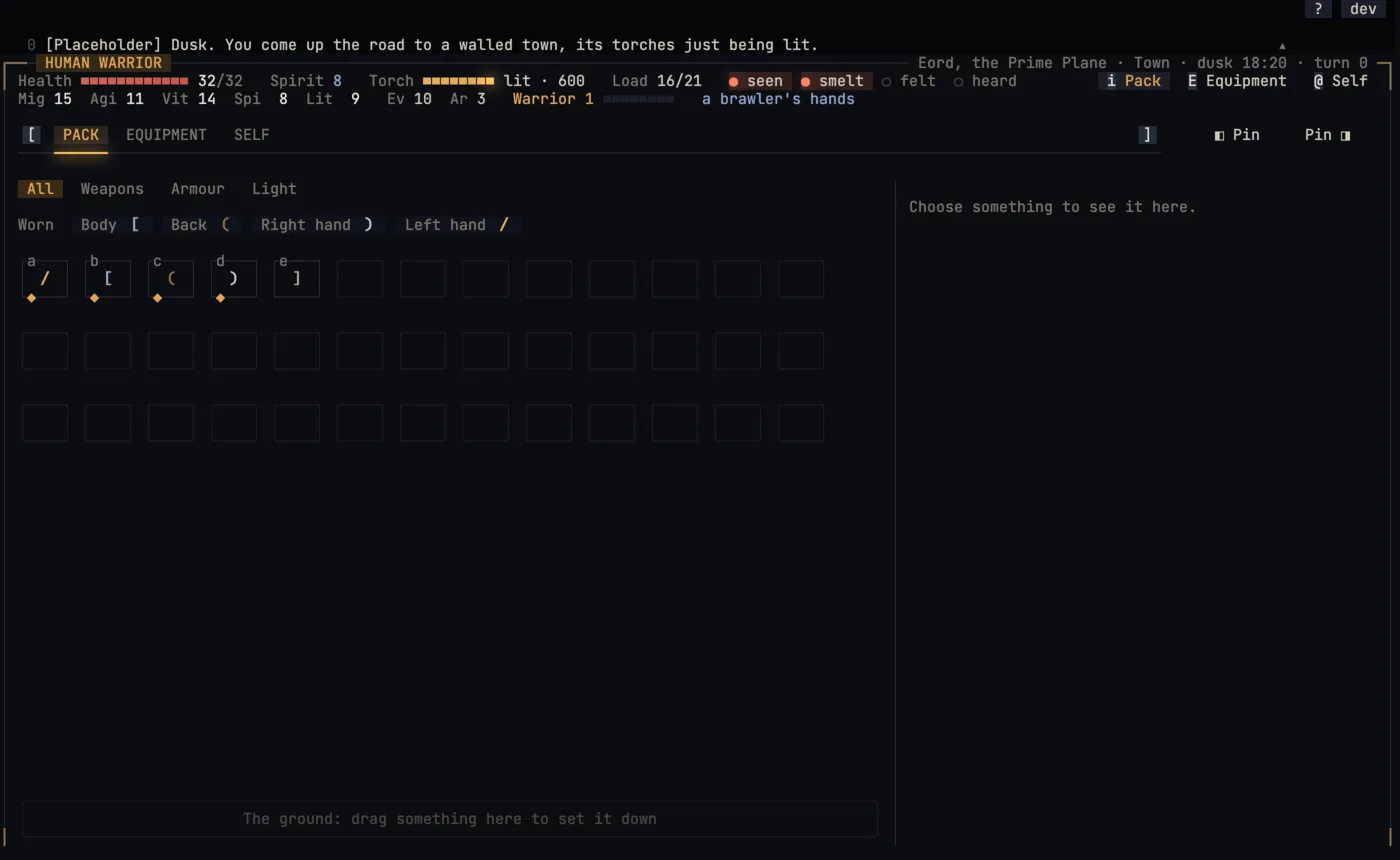
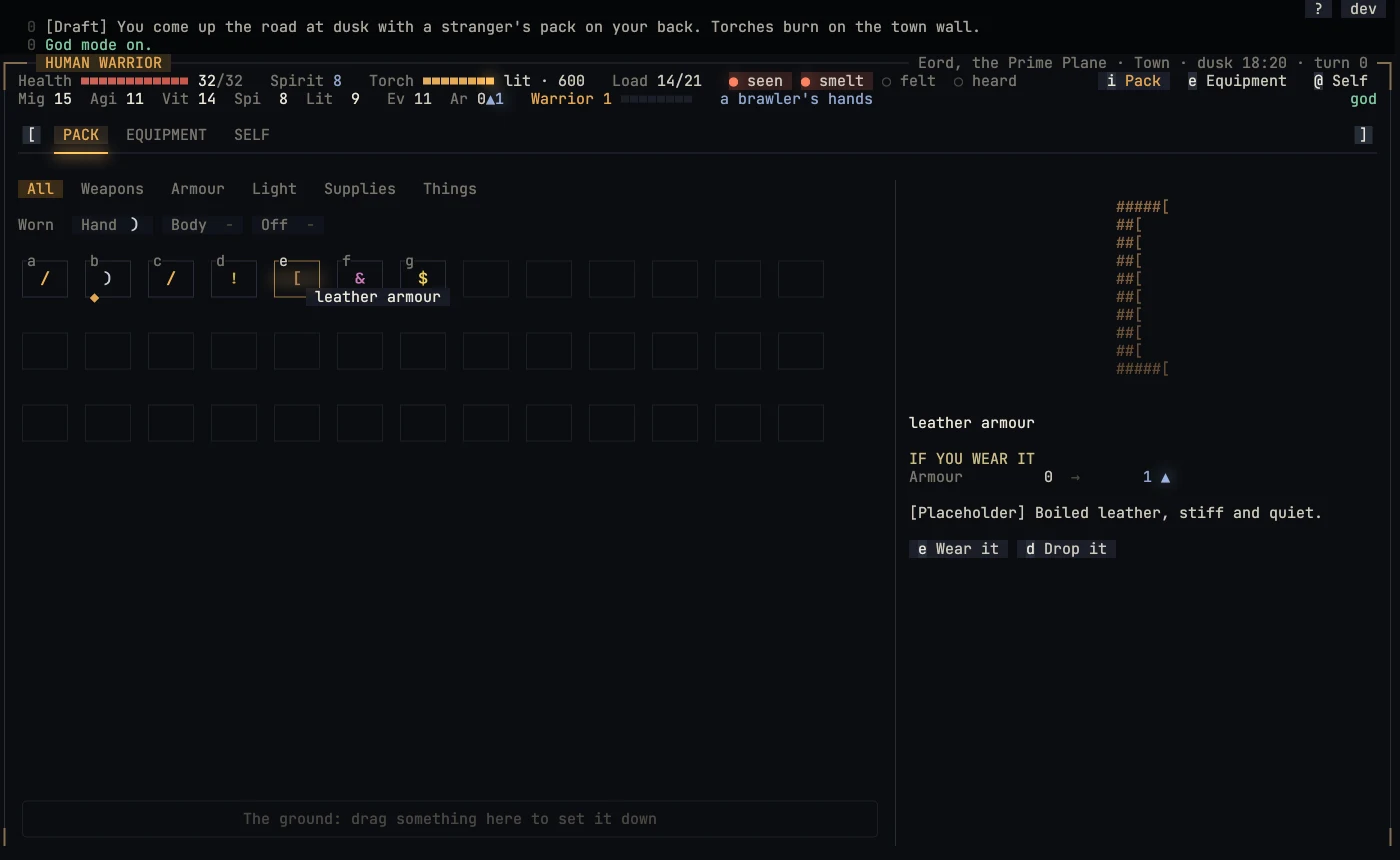
  • The pack is a grid you can sort by kind. Pick something to see it large, with everything you can do with it. Drag it onto the slot it fits to wear it, back into the grid to take it off, or onto the ground to set it down.
  • Anything you could wear or wield shows what it would change before you put it on, like Armour 0 → 1 ▲.
  • Equipment is a lettered list of what you wear and wield, with the weight you carry.
  • Looking is its own mode: press v, move the cursor with the keys or the mouse, and a card beside it says what is there. Enter opens the full description.
  • Windows draw themselves in and write their words in, buttons and lists light up under the pointer, and meters show what you lose before it drains away. Quiet placeholder sounds mark presses, windows opening and closing, and being hurt.
The card risen over the map: status lines along its top, the pack's grid of things, and leather armour picked, showing Armour 0 to 1 if you wear it.

Gentler scrolling, and dev tools rebuilt

On a trackpad, lists and logs scroll as far as your fingers move instead of racing off, and a pinch zooms the map a step at a time. The dev tools behind ` are rebuilt as windows over the game, with a search for anything to spawn.

  • On a trackpad, every list, log and panel scrolls as far as your fingers move, and a pinch zooms the map a step at a time instead of all the way at once.
  • The dev tools (`) are rebuilt: a strip of brushes and switches under the bar, and windows over the game that you can drag, size, roll up and close, and that stay where you leave them.
  • With the dev tools open, press / to search every creature, item, tile and feature. Enter makes the one you picked beside you; or click the map to place it there, and drag to paint tiles.

Stone that holds, and a town that minds

Every kind of ground holds a roof its own way now: earth falls in, stone groans and mostly stands. What you dig stays where it falls. What comes up out of the dark depends on how far from home you dig. And the town wall can be dug through at last, though the town will remember it.

  • Each kind of ground holds a roof as far as it can: sand hardly at all, earth a step, clay two, stone a wide hall, deep rock wider. A roof that spans too far creaks in its own words, then falls by its own chance: earth nearly always, stone seldom, so a great stone hall usually only groans.
  • Rough stone and clay stay where they fall when you walk over them, one heap to a cell, so a long tunnel leaves heaps behind it, not a full pack. Press , to pick them up on purpose. Building takes them from the ground beside you as well as from your pack.
  • What comes out of the dark you dug follows the danger of the land above: near home, a crawler now and then; far out, more of them and worse, blind stalkers, bats and bears among them, and older and tougher the farther you go. Under the town they are rare.
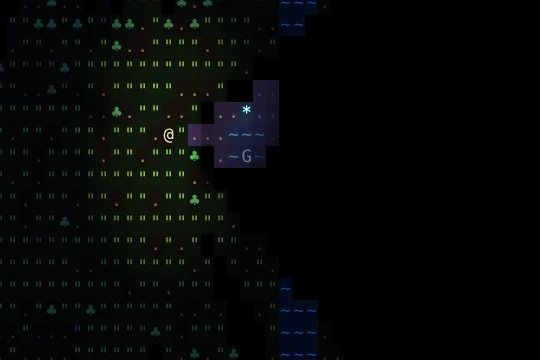
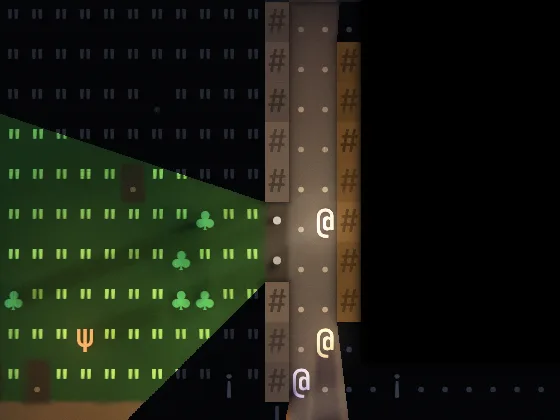
  • The town wall, its gate, the houses and their doors can all be dug now. The wall wants a good iron pick and a long while; doors and the gate want an axe.
  • The town minds. Whoever sees you at it shouts, and won't talk to you the same way after, and the innkeeper has the story by evening. A farm takes it the same way when you dig at its house.
  • A hole dug in the town wall is a breach: if the host comes, it will find it.
Dusk at the town's west wall. Two cells of the wall are dug out, rough stone heaped where they stood, and torchlight spills through the gap onto the grass outside.

The edge of what you see

Where your sight ends follows the light and the line from your eye now, not the tiles. A torch's pool fades out smoothly, a shadow's edge is the shadow's, and the map you remember lies behind it in one even grey.

  • The edge of what you can see follows the light and the walls, never the tiles' steps. A shadow cast by a haystack or a post is the shadow's own shape, and what lies in it reads the same from tile to tile.
  • The edge of the map you have explored follows what you saw, not the tiles: the rim of a torch's pool, the shadow past a wall's corner, the reach of your eyes, in mirrors and through portals too. The walls you know show whole, as blocks.
  • What you remember is drawn in one grey, whether you see it now in the dark or only remember it.
  • A portal seen in a mirror shows its ring and its turning gate, mirrored, and its far side whole.
  • A portal's glass lies on its round opening, not over its whole tile, and a mirror's glass shows on every reflected mirror, as on the real one.
  • In the Glass everything reads mirrored, creatures and letters alike, under one even grey.
  • With darkvision, what is too dim for colour shows in its grey, point by point, and colour comes back smoothly as the light grows.
  • Smoke around a fire is smooth: it veils the flames and the ground evenly, with no squares.
  • Light a mirror sends back, or a portal carries through, shows on screen as the game reckons it: a room with a mirror is lit a little brighter by it.
  • Much faster on large screens, walking past mirrors and portals included.

Down into the ground, and up out of it

Pick up a pick and the world opens. Tunnel into a hillside, dig straight down through the topsoil, the clay and the stone toward bedrock, and build what you need from what you carry: walls, doors, stairs, a hearth, a room of your own underground.

  • Press D and a direction to dig. A pick for rock, a shovel for earth, an axe for trees, a mason's hammer for what was built. Bare hands work only in soft earth, and slowly. Tools wear as you use them, and the trader sells them.
  • D then > digs down through the floor, and you climb into the hole below. D then < cuts rough steps up. The ground goes on down layer by layer, the same for the same world every time, to bedrock twelve layers under.
  • Deep down there are ore seams, gem pockets, still underground pools and natural caves, and now and then something buried: a lost tomb, an old mine gallery, a sealed vault, a collapsed road, a nest.
  • Press B to build from what you carry: stone, timber and wattle walls, plank floors over holes, doors, stairs and ladders between layers, pillars and props, a hearth, a torch sconce, a trapdoor. Rough stone can be dressed into building stone with a hammer.
  • Dig too wide a room in loose earth and the roof creaks, then comes down. Pillars and props hold it up. Rock holds itself up.
  • Picks ring. Things that hunt by ear come to the sound, some of them through the rock. Dark places you dug out, far from any light, don't stay empty for long.
  • Strike a seam of ore and word gets around the inn.
  • The town wall and people's houses can't be dug through.
Night in the hills. A torchlit tunnel runs east into a cliff of bare rock, its walls lit warm where the torch reaches.

Bags of holding and spatial storage rings

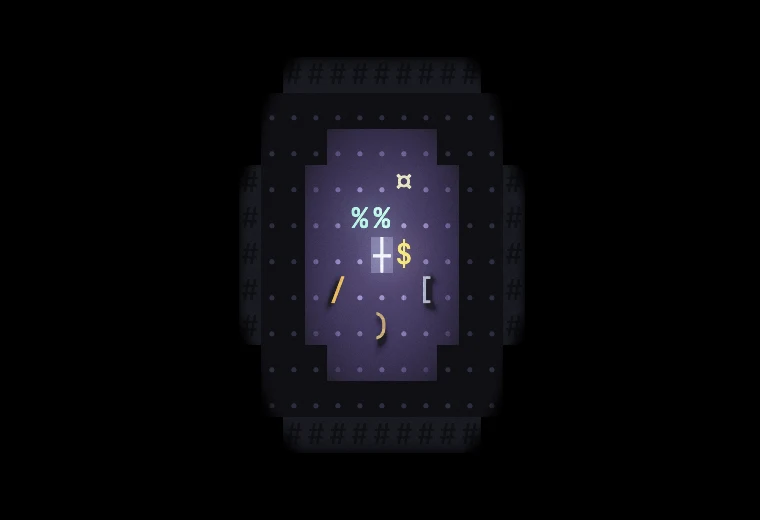
Bags of holding, a portable hole and spatial storage rings carry a small space of their own. What you put in lies there for real, and a ring's inside opens on the map as a room your spirit senses.

  • A bag of holding weighs the same however full it is. Reaching in takes a turn, and in an ordinary bag things lie in a heap you have to rummage through. A handy haversack always brings what you want to the top.
  • Turn a bag inside out and everything in it tumbles out around you.
  • A creature shut in a bag shares its air with everyone else in there, and not for long.
  • Fire and blades wear a bag through. When it tears, what it held is lost to the Between, a grey place where lost things really lie, and a seam there leads back to the road below the town.
  • Put a bag of holding into another pocket and space tears: both are gone, and a rift pulls in whatever is near it.
  • Lay out a portable hole and a pit opens in the ground. Climb down into it with >, climb out with <, and fold it up with everything inside.
  • A spatial storage ring answers only to the soul bound to it. Bind one with your spirit or a drop of blood, and it stays yours in any body you take.
  • Open a ring by thought and its inside takes the map's place, a room seen by your spirit sense. A cursor moves instead of you: take things out, put things in where it rests, and lift things to set them down elsewhere. It costs no time.
  • Your sense reaches only so far. A great ring's far corners stay dim or unknown until your spirit and realm grow, and heavy things will not budge for a weak sense.
  • Time runs slow in a ring, or stops: an herb in a stopped ring never wilts. A ring of high enough grade can be entered bodily. It stays behind on the ground while you are inside, and anyone may pick it up.
  • A ring takes in what lies around a spot you sense, water included: a river's cells drain to shallows and mud and fill the ring, until it is full. Force it past that and it bursts. Pour the water out again on whatever you like.
  • A bag drinks water at its mouth, a few cells a turn, while you hold it there.
  • Rogue cultivators carry rings bound to themselves. When one dies its imprint fades over days, and forcing it sooner against a stronger soul throws you back.
  • A ring of holding is no pocket at all: worn, it simply lets you carry more.
  • The trader sells bags of holding and storage pouches, and pockets turn up in the wilds.
A spatial storage ring sensed from inside: a pale violet room of folded space with herbs, a coin, a torch and a cuirass lying where they were put, fading to dim past the reach of the sense.

At the gates

The town is mostly safe. Once in a long while, it isn't: a host comes out of the east, burns its way across the farms, and comes to the walls by night. What happens that night stays with the town.

  • A siege is rare, and never comes in a run's first weeks. You hear of it days ahead, from the innkeeper and the farmers.
  • While it gathers, smoke stands over the host, refugees walk the road and crowd the inn, and the farms in its path are burned.
  • On its last night the gates are barred and the host comes up out of the dark. It batters the gates, throws burning brands over the walls, and fights whoever it finds. The townsfolk shelter at the inn, bar their doors, and the warden keeps the gate.
  • You can hold the gate, put out fires with the buckets left by the well, or go out and kill the host's leader to end it. You can also leave: the siege is fought out without you, and you hear how it went when you come back.
  • What burned stays burned, and who died stays dead: their trade and their talk are gone, and they are buried by the well. A broken gate stays broken.
  • If the gate held, there is a memorial, prices are kinder, and people greet you as one who stood with them. If the walls were broken, the town mourns, and the country around it is dangerous for a while.
The town the morning after a siege that broke in: the inn and the shop beside it are charred floors inside rings of rubble, and a row of fresh graves lies by the well.

Through mirrors and portals

What you see in a mirror is the room it faces, its light and shadows and all, and what you see through a portal is the far side as it is. They meet properly now: a mirror in a mirror shows another, a portal in a mirror opens onto its far side, and a mirror past a portal shows this side back.

  • The edge of a mirror or a portal is a clean line from your eye, crossing tiles where it crosses them, never a staircase.
  • A reflection is the room it reflects: lit the same, the same shadows, a little dimmer and under the mirror's grey glass. Everything in it is flipped, letters too.
  • Two mirrors facing each other make a corridor of reflections, each a little dimmer than the last, and a room of mirrors shows itself every way.
  • A portal seen in a mirror opens onto its far side, and a mirror past a portal shows what is on this side, you included.
  • A portal opens through its gate, not its whole tile: look past the gate's corners and you see what is beside it.
  • Smoke dims light and sight by how much of it lies in the way, and glows with the light it hangs in, with no hard edge where it begins.
  • A mirror you see a reflection in goes on your map, even in the dark.
  • Ghosts and everything else seen in a mirror take the light where they stand.

Light and shadow

Light is traced now. Every lamp, torch and flame lights what it can reach in a straight line, everything standing in the way throws a soft shadow, and the edge of what you can see is a clean line.

  • Everything stands as tall as it is. A person throws a shadow a few steps long, a lamp high on its post throws short ones, a fire on the floor long ones, and marks on the floor throw none.
  • The town's torches burn from dusk to dawn, as the lamplighter says, each lighting a smaller pool.
  • By day the sun throws shadows that move with the hour: long to the east at dusk, short to the north at noon.
  • Creatures see by the same light. Stand in a shadow and you are harder to see.
  • Trees, posts and other creatures throw shadows but never hide what is behind them. Walls and closed doors do, and the edge of what you can see past them is a clean line, not a staircase.
  • Walls show the light on their side facing you, so from inside a dark room its walls stay dark.
  • Lit floors throw some light back, so shadows beside a lamp are not quite black, and a hearth warms the room around it.
  • Light fades smoothly into darkness, and what you can barely see is never drawn darker than what you remember.
  • Portals look like gates now, and light the ground around them: a ring on the ground, a swirl in the middle that glows, and a shimmering edge around the view onto the far side.
  • The well is a well: dark down its shaft.
  • Zoom in and the light stays smooth: it is worked out finer the closer you look.
  • Water is dark and quiet, darker away from its bank, its colour slowly shifting. Near a torch, a lamp or a fire, the ripples catch its light and flare now and then. The bank is a clean waterline.
  • Where one kind of ground meets another they shade softly into each other instead of meeting along the cells' sides, and walls throw a little shadow at their foot.
  • Grass and reeds are part of the ground: they no longer throw little shadows onto the dirt beside them.
  • The inn's hearth now sits inside the room instead of in the wall.
The inn at night: the hearth lights the room in warm orange, and a person standing in its light throws a long shadow toward the door.

A battlefield that looks like one, and a town that stays safe

The heart of an old battlefield is grim at a glance now. The town is safe from raids. And the world's events take turns: some never come at once.

  • The heart of an old battlefield is churned mud and torn earth, a long trench line with its stakes still leaning toward the enemy, barrow mounds, a toppled standard, and a line of burned wagons with the horses still in their traces.
  • Broken spears, rusted blades, split shields, arrowheads, bones and skulls lie everywhere, thickest around the commander's cairn and thinning out toward the field's edge.
  • You can see over the commander's cairn now, and the crows on the field are easy to spot by day.
  • The town is safe from raids. Bat swarms pick another target, and nothing a raid or a plague does lands inside the walls. A horde passing nearby still makes the country around the town dangerous.
  • Some events never come at once: no eclipse during a blood moon, the warband and the horde never march together, and only one of a hard winter, locusts or the harvest fair comes at a time.
  • Night is more dangerous close to town too, even out on the farmland.
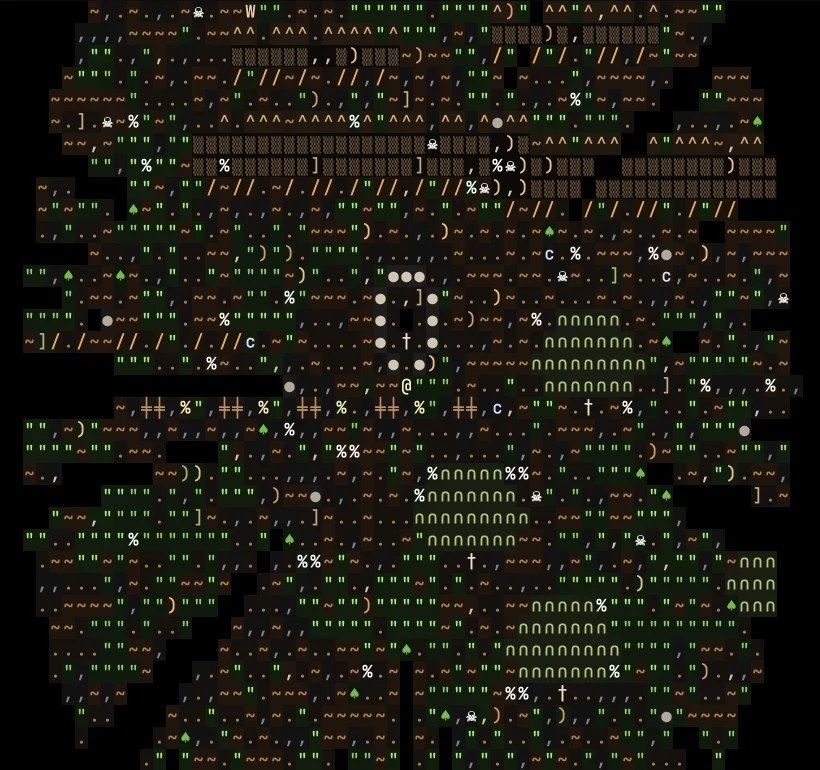
The heart of an old battlefield by day: churned brown mud between patches of grass, two trench lines with sharpened stakes, green barrow mounds, a line of burned wagons with horse bones between them, the stone ring of the commander's cairn, and broken spears, swords, shields, bones, skulls and crows scattered all around.

The farmed country

The town has to eat. The country around it is farms now: hedged fields, farmhouses with smoke at the chimney, sheep and cattle behind their fences, and farmers who keep their own hours. Farther out the farms stand behind palisades. Past that, they're burned.

  • A ring of farmland lies around the town: hedged fields of wheat at every stage, pasture, cart tracks, haystacks and scarecrows. It's a little slower to cross and a little safer.
  • Farmsteads mark the map once you've seen them: homesteads with a barn and a hen-pen, sheep runs, cattle pastures, orchards, a mill by the river. Farther out, fortified farms with a palisade, lookouts and armed farmhands. Past those, abandoned farms gone to thistle, and burned ones.
  • Farmers work the fields by day, eat at the hearth, and go in at dusk, bar the door and sleep. Walk their land by night and they'll shout at you from the window. They won't come out.
  • Sheep, goats, cattle, pigs and chickens graze inside their fences, keep together, and run from wolves. Wolves come over the fence. The farm dog barks, and goes for them.
  • Crops grow over days, whether you're watching or not. Come back in a week and the field has moved on. Ripe wheat can be reaped and apples picked. If it's someone else's field, it's theft.
  • Farmers remember. Steal from them and they won't trade with you; hurt their animals and they'll come for you; kill the wolves troubling them and they'll thank you with something from the larder.
  • Farmers sell eggs, milk, cheese, wool, cider, seed and turnips, and animals: buy a pig and it follows you home, across the map and in at the town gate.
  • Build a garden bed on your plot, plant turnip seed, and pull turnips a few days later.
  • Rumours come from people now. Ask the innkeeper at the inn what's going on; farmers talk about their own country (the wolves, last night's raid, the fair); the carter and the gate warden pass one on now and then.
  • The town keeps hours too: the lamplighter makes the rounds of the lamps at dusk and dawn, and the innkeeper keeps the hearth by day and sleeps at night. During the harvest fair the farmers go to town.
  • Bat swarms empty the pens and leave the straw bloody; locusts strip the fields; a hard winter freezes them bare.
A homestead in the farmland by day: hedged fields of ripe gold wheat, green young wheat, ploughed furrows and pasture, a farmhouse with a lit hearth, a hen-pen behind a fence, haystacks, a scarecrow, a stream, and the farmer out sowing a field.

The farther from home, the worse it gets

The country near the town is where you learn. Walk far enough and it turns on you: more trouble, worse trouble, and creatures that have lived a long time out there. The far country pays better too. And the world has its own weather now: full moons, a rare blood moon, eclipses, warbands, bats, locusts. Somewhere out east lies an old battlefield.

  • Danger grows the farther you walk from town. Near home it's what it always was. Out in the wild country you meet things more often, in bigger packs, and new things: dire wolves, cave bears, hill trolls, and what lives in the barrows.
  • Far out, creatures come grizzled, elder or dread: tougher, harder-hitting, sometimes armoured. It shows in their name, even when you don't know what they are.
  • The log tells you as you go: "The land grows wilder here." Coming back, a softer line. Look at the map and it says how far out a place is, in words.
  • Some places are worse than their distance: the Barrowdowns, a bandit-held pass, the country around a wolf den or an ambush. Clear a place out and the land around it settles.
  • The finds are better far out: a traveller's purse in the grass, a cache under a fallen tree, a talisman in a cairn.
  • The moon waxes and wanes. On a full moon the nights are bright and the wolves run. Rarely, the full moon rises red, and the old things wake.
  • The world has its own events: a noon eclipse, a hard winter, a harvest fair that makes the roads near town safer, a warband marching from the east, a horde out of the south-east, bat swarms raiding the farms by night, locusts stripping the fields. You hear rumours of them in town, and come back to places to find what they left.
  • Old battlefields lie in the far country, the Field of Broken Spears among them: churned ground, trenches and grave rows, rusted blades and arrowheads thick toward the heart, crows, and a commander's cairn with writing on it. By day, grave-robbers. By night, the dead are still holding the line.
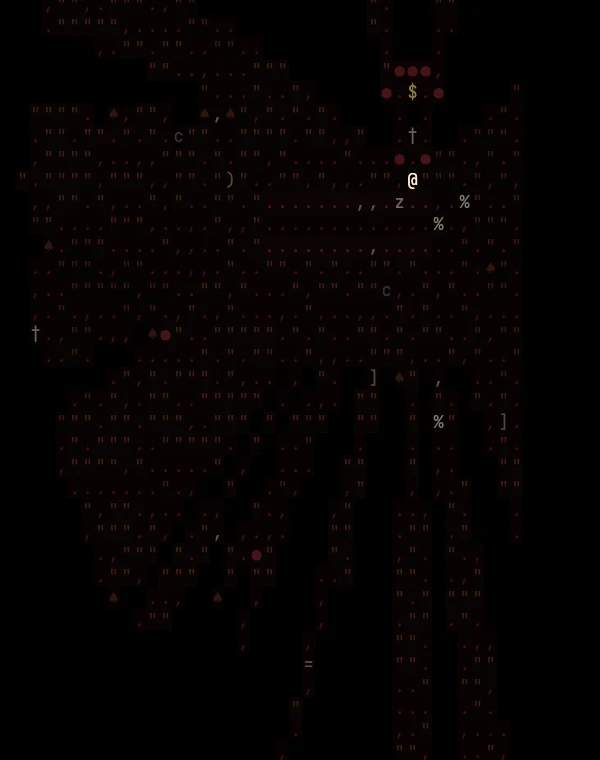
The heart of an old battlefield under a blood moon: the whole map washed dark red, a ring of stones around the commander's cairn, grave markers, rusted gear on the ground and a risen soldier beside the player.

Every step counts

The country between the places you know is full now: shrines and graves, camps and dens, a hermit, a collapsed mine, and stranger things. Every step across the map brings something. Nights are slower, darker and worse. And behind the mirrors run the High Roads.

  • You're new here. You start knowing only the town; everything else is yours to find.
  • Every stretch of country holds something: a wayside shrine, a grave with writing on it, an abandoned camp, a spring, a herb patch, a hunter's blind, a burned farm, a bandit ambush, a ring of toadstools that is busier at night, a mine fallen in with a way down. Some are landmarks, and once you've seen one it stays on your map with its own mark.
  • A step across the map is rarely nothing: tracks, a sound in the dark, the weather turning, a find, someone passing on the road, a landmark sighted from a rise.
  • Stepping onto a place now names it. Press > to go in. > anywhere else goes down into the land you're on, beside its landmark if it has one.
  • Night is harder. Steps take half as long again, you see less (a lit torch helps a little), what you meet is nastier and comes more often, and off the road you can lose the path and come out somewhere you didn't mean to.
  • Press R on the map to make camp and wait for first light, or by day for evening. Something may find your camp.
  • Somewhere in the woods stands an old mirror. Step through it into the Glass and go up: the Glass has no map of its own, only the High Roads, grey ways across the dark joining every place in Eord that holds a mirror. One step on them covers miles. Things walk them.
  • The places you've left keep living while you're away, and the game catches up the ones beside you while it's idle, so coming back, even after days, is instant.
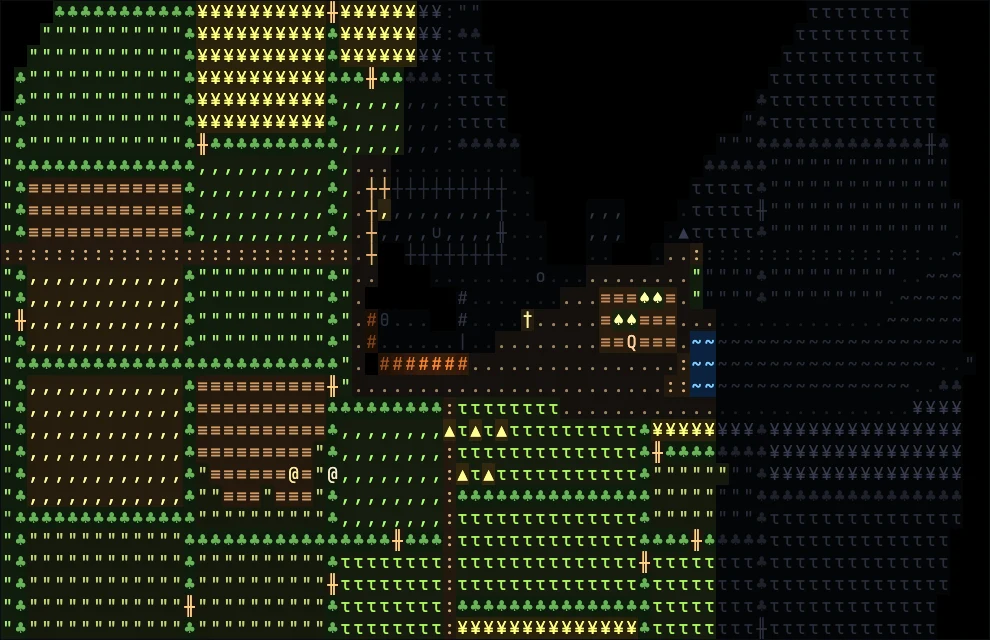
The same stretch of map by day and by night. By day the plains around the player are bright green, with the town, the proving ground, an old ruin and a lone cottage marked. By night only a small dim circle of the country can be seen.

Every creature has a core

Every creature now has a core, and some have cultivated and are stronger for it. Cut cores from the fallen to sell, build with or absorb. And if you choose, take up cultivation: one path to power among many, where every realm you break through changes how the world looks.

  • Every creature has a core: how refined it is, what kind of qi it holds, how pure. Some creatures have cultivated and are stronger than others of their kind. On the Glass Mere, where the path is common, the wolves are fiercer.
  • Where a creature dies it leaves remains. Stand on or beside them and press o to cut the core out. A good blade helps.
  • Cores sell to the trader by grade, and a cored simulacrum is built round one.
  • Press O to see cultivation. You never have to: it's one path among many and nothing is lost by leaving it. Sit and meditate to begin. Sitting gathers qi, and once your body is full it slowly opens more of its meridians. A body that cannot channel qi can't.
  • Break through to a realm with enough qi and its trial done. Each opens a sense: qi sense shows cores and qi glowing through the dark, a little brighter for a stronger creature; spirit sight shows the dead; at the third realm you see where fire would take and lightning would run before you act, for the reactions you know. Further realms let your mind hold together outside your body, and at the peak, read the world's own writing.
  • A breakthrough takes the whole screen. So does going wrong: overreach, impure cores, or being disturbed turn your qi. A deviation makes you see and hear things, forget things, bleed, and sometimes changes your body. The cultivation screen shows the odds as your body feels them.
  • Realms teach techniques worked with qi: a palm strike, a breath that puts out fire, a lightning step. Use them from X like any skill.
  • Cultivation belongs to your mind and goes with you into another body; meridians you open in a possessed wolf stay with the wolf.
  • The disciple sent down the mountain begins already cultivating, at the door of the first realm. Out in the hills and forests there are qi seeps, and a hermit's manual.
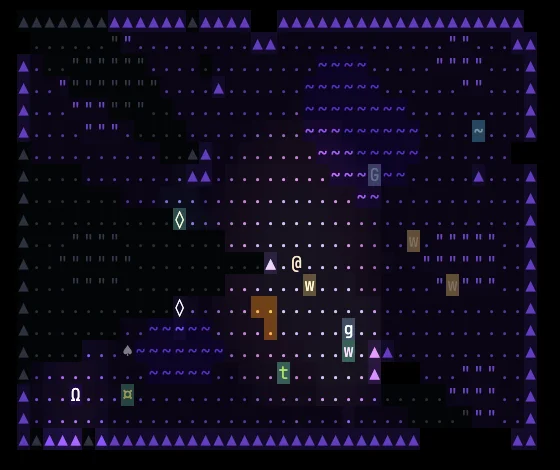
The Glass Shore under a violet sky, seen by a cultivator three realms in: wolves, a toad and a guardian tinted by the glow of their cores, a ghost standing plain beside a wolf, and spilled oil washed orange where fire would take.

The wide world

The town is no longer alone. Step out onto a map of Eord where every tile is a whole stretch of country, walk it a day at a time, and step down anywhere into land made fresh for your run.

  • Press < on open ground to go up onto the map of Eord. You walk it as one figure, and each step takes as long as the country does: half an hour on the road, an hour across the plains, two in forest, three through the marsh. The clock, your torch and your wounds go on as you walk.
  • Press > to go down into the land you're standing on, at the edge you came in from. Walking onto the town or the proving ground takes you straight in.
  • Every stretch of country between them is made new for each run: forest and hills, plains and marsh, a river that runs on from one stretch into the next, and a road that leads out of the town gate. Some hills have caves under them.
  • Walk off the edge of any place and you come into the next one. The sea and the high mountains stop you.
  • On the road you may meet someone. Wolves in the forest, someone going through the grass: you're dropped into the land where it happens, with them close.
  • You only know the country you've seen. From hills you see far; in forest, hardly at all. The town and the land around it you know from the start.
  • Press M (or Map on a phone) for the map of the world: where you've been, the places you know, where you are and where your plot is.
  • Places stay as you left them, and time doesn't stop while you're gone. Come back to a fire you left burning and it has burned out; creatures have wandered off. If something got into your house while you were away, you hear about it when you're back.
  • There are cottages, ruins and wolf dens out there, somewhere different every run.
  • Behind the mirrors, the Glass has the whole map too, turned east to west. A cursed mirror out in the wilds leads to the same wilds behind the glass.
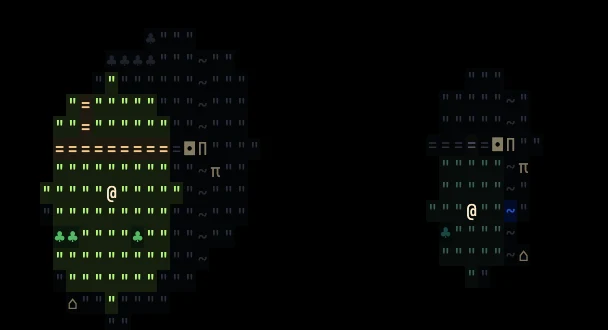
The map of Eord by day: the player stands on a road beside a river, bright in the country they can see, with forest, plains and hills they walked through earlier remembered dimly to the north.

Learning the world

What your character knows is now the progression. Creatures you've never met have no names, strange items are only their looks, and the rules of fire, water and lightning go unannounced until you've seen them happen. Learn, and the same things gain names, details and numbers.

  • A creature you don't know is only what it looks like: a grey four-legged beast. Read about it, be told about it, ride inside one, or watch one die, and from then on it's a wolf.
  • Looking at a creature shows what you know about it: what hurts it and by how much, what it fears, how it senses you. What you've only seen once is marked as a guess until you see it again.
  • The first time you see lightning strike the iron guardian, all you see is it shudder. Once you've seen it twice, you know: lightning hurts metal things, twice over.
  • The journal is now a codex: everything you know this run, by kind (writing, creatures, items, reactions, scripts, places and shapes), with how you learned each. Press r, and Tab or the arrow keys to move between kinds.
  • Literacy is now how well you know each script. Reading something new improves your letters a little, and pages you've kept read more clearly as you learn. The called arrive barely able to read the local letters, and there are scripts from far away nobody here knows.
  • What you know belongs to your mind and goes with it into any body. A body's own instincts don't: wear a wolf and you know every creature of its forest by scent, until you leave it.
  • The deserter knows the pale dead from the northern line. The gate warden will tell you about the wolves in the hills.
  • Wear a wolf's body, and a fox-blooded character learns the wolf's shape.
  • A qi deviation can make you forget something you knew.
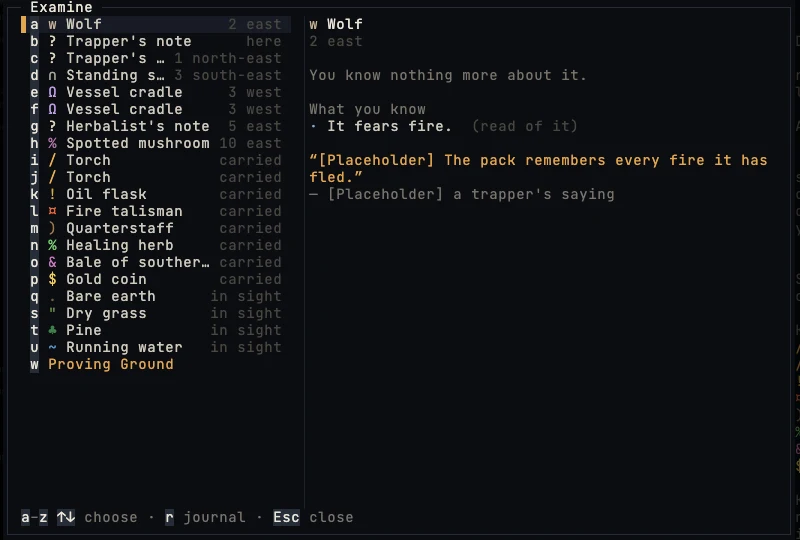
The examine screen: a wolf two cells east, known by name now, with a line under What you know saying it fears fire, learned by reading of it, and a trapper's saying quoted beneath.

Hunted by every sense

Creatures now hunt with the senses they have, and only those. Stay out of the light, stand still, cross water, keep quiet: you're hidden from anything none of whose senses can find you. And your own senses can lie to you.

  • You leave a scent trail wherever you walk. Wolves follow it, even long after you've passed. Water washes it away and fire burns it off, so crossing the river breaks it, and you come out wet and smelling of nothing for a while.
  • The iron guardian feels footsteps through the ground. In the dark it finds you when you move, and not when you stand still. Light feet carry half as far.
  • Fighting, shoving, and glass breaking are heard. Creatures that hear something come to look; throw a flask far off and they go to see what broke.
  • A blind stalker hunts by sound alone, and a creature of shadow called the umbra can only exist where light falls: douse your torch and it's gone.
  • Ghosts nudge things lying near them, and you feel the air turn cold when one comes close.
  • Illusions fool the eye and nothing else. There's a wall in the ruins you can walk straight through, a floor that isn't there, and something that looks like a fellow traveller. Spirit sight sees them for what they are, and where your other senses disagree with your eyes, the spot shimmers.
  • Fear, poison and qi gone astray make you see what isn't there: shapes at the edge of the light, colours that slide, a log that tells you things that never happened. A spotted mushroom in the proving ground will show you.
  • The panel shows which senses could find you right now: seen, smelt, felt, heard.
  • Possess a wolf and you see the scent trails around you; possess the guardian and you feel the illusory wall for what it is.
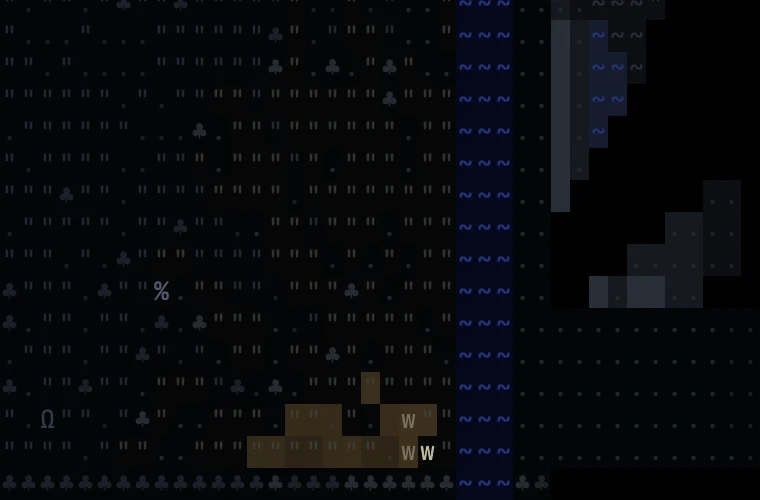
Night by the river, seen through a wolf's nose in blues and greys. A brown scent trail runs across the grass and stops dead at the water's edge, where three wolves have lost it.

Behind the mirrors

A cursed mirror in the caves under the ruins is a door. Walk into it and you come out in the Glass: the whole world reflected, east turned to west, with no sky, lit only where the world's mirrors and still pools look. Ghosts live there, and you can see them plainly.

  • Find the cursed mirror in the caves, near the stairs, and walk into it. You come out at the matching place behind the glass. Its twin there is the way back.
  • The Glass has no sky. Its light is the world's light, lent only where a mirror or a still pool in the world looks, so there are pools of light and darkness between. Your torch burns weak there.
  • Everything you see in the Glass is washed in the grey of a mirror.
  • Ghosts are at home in the Glass. There you see them as they are, not as cold air.
  • What you do on one side touches the other. Burn, build or break a wall in the world and it changes behind the glass, and the other way round.
  • Mirrors are brittle. Throw something at one and it shatters into an empty frame, and its twin on the other side shatters too. Break the mirror you came through and you're stranded.
  • Stay in the Glass long enough and you gain a new skill, Mirror Walking: walk into any whole mirror, either way, for a little spirit. A dull, tarnished mirror won't take you.
  • There's an ember brazier by the road outside the town walls, too. Walk into it and see the town as it would be after a fire.
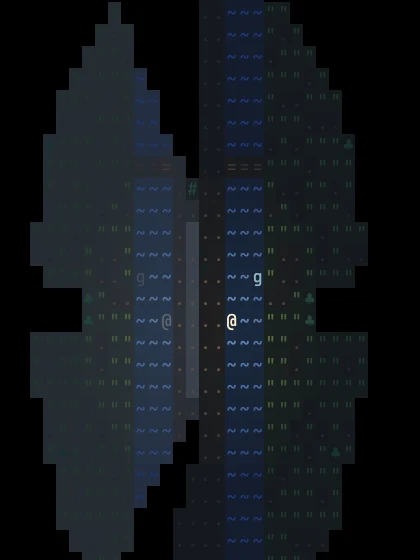
Behind the glass, under a grey wash: a long pool of reflected light around a mirror wall, a river and grass lit faintly inside it and darkness all round. The player stands by the river, and a pale ghost stands plainly beside them and again in the mirror.

Bodies that change

Your body can change during a run: grow fox eyes, gills or a third arm, go colourblind, or take the shape of a fox. Strong qi, strange springs, odd food and certain bites all do it, and clear water can wash it out again.

  • Fifteen changes a body can go through: eyes that see in the dark but lose all colour, stone skin that makes you heavy enough to break rotten floors, ember blood that shrugs off fire but hates the cold, a wolf's nose, feet that feel footsteps, an extra arm that holds a second thing, gills, glass bones, seeing ghosts plainly, seeing the warmth of living things through darkness and smoke, hearing where things move through walls, skin that glows, and more.
  • When your body changes, the screen tells you and the log says how it feels. You may not know what a change does until you notice it: the character panel lists it as a feeling at first, and names it once you understand.
  • Strong qi can change a living body, and lightning through a qi-bearing body can too. On the Glass Shore there is a spring that changes whoever lingers in it, pale mushrooms that do the same, a toad whose bite does it, and a wolf that has already drunk from the spring.
  • A clear spring on the shore washes changes out, newest first. A glass leech feeds on them.
  • Changes belong to the body. Leave your body and they stay with it; take over a changed creature and its changes are yours while you are in it. From a body you have taken, you can tear a change out and set it in your own body lying beside you, at a cost in spirit and blood.
  • The fox-blooded can take the shape of a fox, and the stoneborn a shape of stone, with the new % key. Changing takes a few turns and some spirit. You keep your mind and your wounds; a shape without hands holds your gear until you change back.
  • Strong qi now heals the living a little, as the rules always said it would.
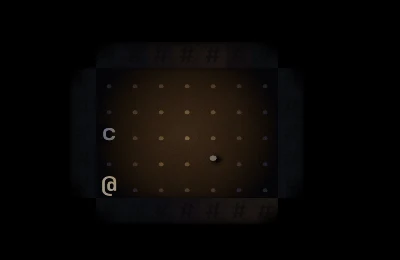
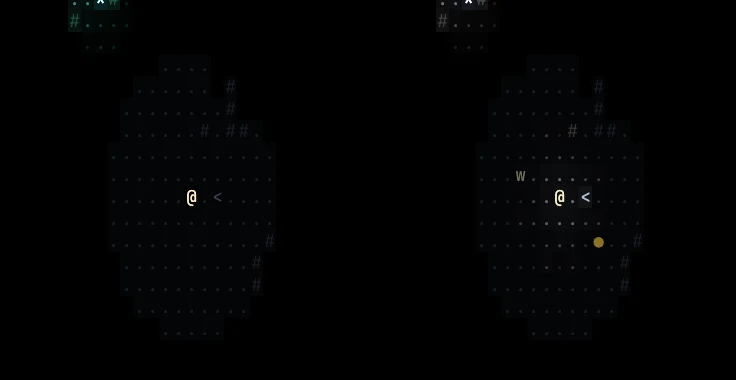
Two views of the same dark cave. On the left, without a torch, the player sees only remembered floor. On the right, after three changes, a wolf shows nearby in the player's own faint light and a warm orange dot marks a creature unseen in the dark.

You become what you do

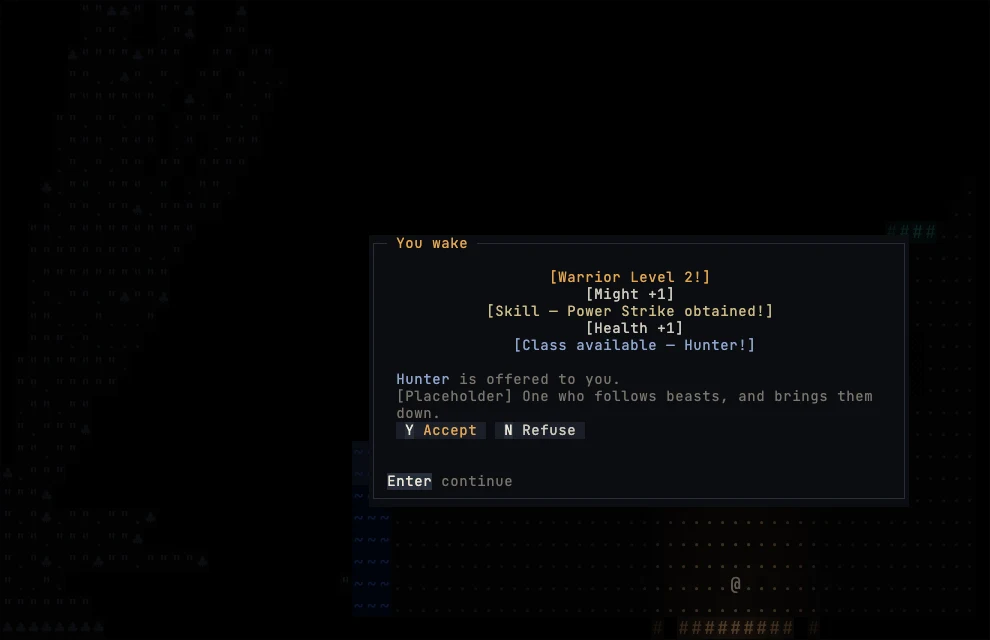
Classes now grow from what you do. Fight and your Warrior levels climb; bring down beasts and the Hunter is offered to you. You level up when you sleep, and wake to [Warrior Level 2!] and [Skill — Power Strike obtained!].

  • The calling you choose at the start is level 1 of its class. Everything you do can feed a class: blows struck, foes felled, writing read, things built, creatures caught in a fire you set.
  • Experience piles up while you're awake. You gain levels when you sleep, and waking shows each level, stat and skill in turn.
  • Press R to sleep where you stand: in your own bed, or rough on the ground if there's no bed. Sleeping rough is shorter, heals less, gives at most one level a night, and leaves you out in the open.
  • Do enough of what a class you don't have does and it's offered when you wake. Accept it or turn it away. You can hold three classes at most.
  • Skills come with levels, and some levels let you choose between two. Passive skills change you: tougher hide, lighter feet, eyes for the dark. Active ones are things you do: Power Strike hits harder and drives the foe back, War Cry sends what's near running, Mending Touch closes your wounds, Kindle sets the next cell alight.
  • Press X for your classes and skills: each class's level, how close the next is, what fed it lately, and every skill. Press an active skill's letter to use it.
  • A class can change as it grows. A warrior who fights in the dark long enough may become something else.
  • Your classes and skills belong to your mind. Possess a wolf and they go with you, but a wolf has no hands for a weapon art.
A box titled You wake over the dark ruins at night, announcing Warrior Level 2, Might +1, the skill Power Strike, Health +1, and the Hunter class offered, with Accept and Refuse buttons.

The world has depth

The ruins and the caves beneath them are one place now, stacked one over the other. Look down the chasm and you see the caves; drop a torch in and it lights them; step in and you fall.

  • The caves lie under the ruins, and both are alive at once: what happens below goes on while you walk above.
  • Look into the chasm and you see the cave floor beneath it, dimmer and cooler the deeper it lies, and whatever stands down there where the light reaches.
  • Throw your lit torch down the chasm and it lights the cave below. Light falls the other way too: the sky reaches a little way down a shaft.
  • Walk into a drop and you stop at the edge; walk into it again and you jump. You land in the caves, hurt. Things you throw or drop in fall too.
  • Take the stairs with < and > to go down to the caves and back up. Creatures follow you by the stairs.
  • Smoke rises up through a chasm, fire in the caves can catch the grass at its rim, oil poured in runs down to the floor below, and you hear what moves beneath you, muffled.
  • The top bar says how deep you are: the ruins, or the caves.
  • Saves from before this can't be continued: the game says so in one line and starts a new run.
At dusk, the player stands at the edge of a dark square chasm in the ruins. Down through it, a thrown torch lies burning on the cave floor below, lighting it faintly.

Ghosts in the glass

Ghosts can no longer be seen at all, except in a mirror. Find a mirror, or hold one out, to see what's standing beside you.

  • Ghosts are invisible to the eye, even in full light. In a mirror they show plainly, as what they are.
  • When one touches you unseen, it's still only cold air.
  • The fox-blooded, and anything else with spirit sight, still see ghosts directly. So do ghosts: they see each other.

Walk on, and mirrors that dull

Stepping yourself, nothing stops you when a creature comes into view. And every mirror now has a reflectivity: a reflection is only as bright as the mirror sends back.

  • "A wolf comes into view" and its short pause only happen while you're walking to a clicked spot, where the walk stops so you see it. Moving with the keys, nothing interrupts you.
  • Mirrors send back only part of the light that strikes them. Reflections are dimmer than what they show, a dim corner may not show in a mirror at all, and torchlight thrown back off one is weaker.
  • Creatures see by the same rule: a wolf can't spot you in a mirror too dull to show you.

Truer reflections

A mirror now shows the ground you remember behind trees and rocks, just like on your side of the glass, and your reflection never passes for you.

  • Your reflection, and any creature's, is a dim silver copy, so you can always tell which one is you.
  • Where something hides part of a reflection, you see your memory of the reflected ground there, not whatever stands behind the mirror.

A town, and a house of your own

Every run now begins on the road to a walled town at dusk. Choose who you were before you came, trade with the town's trader, claim the plot past the wall and build a house to sleep in.

  • Character creation has a third choice, your origin: who you were before you came up the road. Each one starts you with different things, and the deed starts you with a burned-out plot already yours.
  • The town is safe: lamplight, a gate warden, an innkeeper and others going about their business. Walk into them and they talk. The road east leads to the proving ground.
  • Time passes. Runs start at dusk, the town gets dark at night and light at dawn, and the top bar shows the time.
  • A trader buys and sells: timber, stone and cloth for building, and gear. Walk into the trader or press o beside them.
  • Stand on the plot past the north-east wall and press o to claim it. Then press b to build: walls of timber or stone, doors, floors, a bed, a hearth, a chest and a workbench. Each costs materials and takes time, and you can take things down again for some of them back.
  • What you build follows the same rules as everything else. Timber burns, a shut door blocks sight and keeps wolves out, and a lit hearth lights the room.
  • Sleep in your own bed (o) and the night passes while you heal, faster by a lit hearth. If something gets into your house, you'll hear about it.
  • Chests keep what you put in them for the rest of the run.
At night, a one-room timber house lit orange from inside by its hearth. The player stands between the hearth and the bed, with a chest beside them and the door shut.

Your mind can outlive your body

What you are is now separate from the body you're in. Grow a clone, bind yourself to a phylactery, send out a simulacrum, or reach into the creature beside you, and none of it comes cheap.

  • Two vessel cradles stand at the south-west edge of the Proving Ground. Bring them rare materials and gold and they'll make you a clone, a simulacrum or a phylactery, over many turns.
  • With a phylactery intact somewhere, dying isn't the end: you wake in a clone waiting in a cradle, and your old gear lies where you fell. With no clone you linger as a fading shade that can pass through walls. Lose the phylactery and the next death is your last.
  • Lie down in a cradle and send your mind into a simulacrum. It's weaker than you and wears away, and if it falls you wake at home, shaken: your spirit drops and your body aches.
  • Press p to possess the creature beside you, a contest of your spirit against its will, or g to ride inside it and see what it sees while it goes where it will. A body you hurt and abandon may come after you later.
  • Your memory of the map, your spirit and what you know go with you from body to body. Senses, gear and strength belong to the body: a wolf can't read, however learned you are.
  • Ghosts, the iron guardian and the scavenger now carry the materials and gold you need, and scavengers will pick up anything precious they find, a phylactery included.
  • Press m for your mind and vessels: the body you're in, where your phylactery is, the bodies waiting for you, and what each vessel costs. On phones it's the Mind button.
Torchlit grass at night beside a vessel cradle. The player, just woken in a clone of themselves, stands in a violet flash, with their dropped gear lying nearby.

New things to carry, and new things to do with them

Seven new items, each a new way to act on the world rather than a bigger number, and some of them you won't recognise until you've used one or seen one used.

  • A waterskin: pour it on a fire to put it out, or throw it to soak the ground, which then carries lightning to whoever stands in it. Fill it again at a pool or the river.
  • An oil lamp: a wider light than a torch, which keeps burning when you set it down. Refill it from an oil flask.
  • A coil of rope: tie it at the edge of a drop and climb down to the Undercroft, then climb back up the same way. There's a new chasm in the east of the Proving Ground.
  • A qi talisman: press it on a ghost beside you, or throw it, to wound it. The living feel nothing.
  • A hand mirror: hold it out beside you to see around a corner. A ghost that catches its own gaze in it freezes.
  • Salt: scatter a line of it, and ghosts won't cross it or strike at you while you stand on it. Water washes it away.
  • A healing herb: eat it to close your wounds. Scavengers carry them and eat them when they're hurt.
  • Some things look unfamiliar at first, like a "sprig of bitter leaves" or a "pale talisman". Use one, watch someone else use one, or read about it, and you'll know it for the rest of the run.
  • The inventory lists what each item can do. When a use needs a direction, pick it with a movement key, or tap the cell beside you.
  • Inventory letters skip i, so the ninth thing you carry no longer closes the inventory when you pick it.
A lit stone room in the ruins. The player stands in the middle of a short line of salt, drawn as white crosses above and below them.

Look closer, and keep what you read

You can now examine anything you perceive for its full description, and a journal keeps every note and inscription you find. Writing in the world's own script comes clearer as your literacy grows.

  • Press v to examine what you perceive: creatures, things on the ground, what you carry, the ground itself and the place you're in. Clicking a line in the look panel opens it too, and on phones there's a Look button.
  • Some things now come with a quote under their description. Most are still placeholders while the real ones are written.
  • Notes and inscriptions can be written in the world's own script. What your character can't read shows as unknown letters, and a partly readable text gives up some of its words.
  • Press r for your journal: every note you've read and every inscription you've seen this run. Pages are read again each time you open them, so learning to read better reveals more of what you already found.
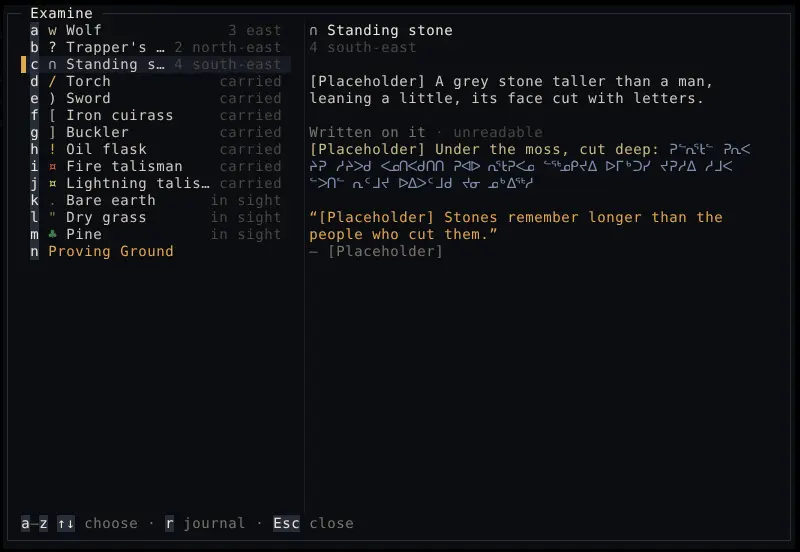
  • A standing stone near the start of the Proving Ground has something cut into it.
  • A run saved before this update carries on, but without a journal. Start a new run to keep one.
The examine screen over the map at night: a list of what the character perceives, and a standing stone's description, with part of its inscription in unknown angular letters and a quote below.

A gate to another plane

Eord is the Prime Plane, and now there are others. A planar gate in the proving ground leads to a small test plane under a different sky, where some of the world's rules work differently.

  • A planar gate stands in the grass near where you start. Step into it to cross; step back through to come home.
  • Each plane has its own sky. Crossing shows it at once, and the top bar now names the plane as well as the place.
  • Planes can bend the rules: on the test plane, lightning that hits water goes no further instead of racing across it.
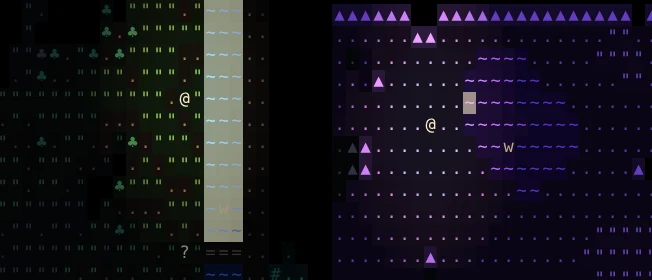
Two scenes side by side. Left: at night, lightning lights up a whole river and the wolf wading downstream. Right: under a violet sky, the same throw lights a single cell of a lake, and the wolf in the water beyond is untouched.

Creatures hunt for their own reasons

Creatures now choose what to go after by what they are, not by who you are, and what you carry finally weighs something.

  • Wolves and ghosts go after people and other beasts; the guardian keeps to its post. Possess a wolf and its pack leaves you be and turns on the body you left behind.
  • Anything you hit, shove or throw at will turn on you, even its own kind, and badly hurt wolves break off and run.
  • You can drop anything you carry, wear or hold from the inventory (d). Creatures that die leave their gear where they fall.
  • Carrying too much slows you down: past your limit you're burdened, and past half as much again you're overloaded. Your load shows on the character sheet and in the inventory.
  • A scavenger now wanders the undercroft, picking up and using what it finds.
  • On phones, a Self button opens your character sheet (@ on a keyboard).

A moment to look

When a creature comes into view, the game says so and holds the next turn for a moment, so nothing slips in and out of sight before you've seen it.

  • A creature coming into view is announced ("A wolf comes into view.") and turns wait about half a second.
  • Holding a movement key doesn't carry you on past it: let go and press again to keep moving.
  • The cursor, the throw target and a walk's destination no longer show up in mirrors or through portals. They're drawn once, where they are on screen.

What you see depends on who you are

The world under the hood was rebuilt so every creature and item works the same way, and what's on screen is now what your character can actually perceive.

  • Fox-blooded characters see ghosts plainly. Everyone else only feels a patch of cold air.
  • Stoneborn and fox-blooded darkvision shows the dark in shades without colour.
  • Fighting something you can't see now reads "Something misses you." and a blow your armour stops reads as glancing off.
  • Being slowed now makes you act less often, turn by turn, rather than skipping whole turns.
  • Your torch burns, gets knocked loose, douses in water and relights the same way as any other light.
  • Saves from before this update can't be continued. Start a new run.

Click to walk

Click (or tap) anywhere you've seen and your character walks there, one turn at a time, and stops the moment something needs your attention.

  • The walk finds its own way around walls, water and fire, through portals too, but only over ground you've seen or remember.
  • It stops when a creature comes into sight, when you're hurt, when something new turns up in the message log, or when you press any key or click again.
  • With a creature already in sight, a click takes a single step instead, so you never sleepwalk into a fight.
  • Clicking into the dark still takes one step towards it.

Play on your phone, and mirrors that keep up

Moving on a phone is now a swipe or a tap anywhere on the map, and reflections no longer run a step ahead of you.

  • Swipe on the map to walk, or tap a spot to step towards it. The on-screen d-pad is gone, so the map gets the whole screen.
  • Reflections in mirrors and the views through portals now move in step with you instead of one step early.

Who you are: races, classes and a fight worth having

A run now starts with a choice of race and class, and fighting is rolled from your stats and gear instead of a flat hit.

  • Four races (human, sylvan, stoneborn and fox-blooded) and four classes (warrior, hunter, qi cultivator and scholar), each with its own stats, traits and starting kit.
  • Five stats: might, agility, vitality, spirit and literacy.
  • Equip what you carry in your hand, on your body and in your off hand. Swords, spears that reach two cells, quarterstaffs, leather armour, iron cuirasses and bucklers.
  • Melee is rolled: agility decides whether you hit, might how hard, armour how much gets through. You can shove things, too.
  • Stoneborn and fox-blooded characters see a little way into the dark without a torch.
A stoneborn hunter with the torch out. A small patch of floor around them shows in dim grey, and glowing fungus lights a few cells to the north.

Runs that survive closing the tab

Close the tab in the middle of a run and it's waiting when you come back.

  • The game saves as you play, in your browser's storage, and loads the run when you return.
  • Saves are small and quick to load, even after a long run.
  • Death ends the run and its save, as it should.
Torchlight on the floor of the Undercroft beside the up stairs. A pale ghost, drawn as a g, stands next to the player.

Every screen drawn in glyphs

The panels, the message log, the inventory, the help and the developer tools are all drawn by the game's own renderer now, on the same grid as the map.

  • One look from edge to edge: health and torch meters, your pack, what you're looking at, and the message log, all in glyphs.
  • Works the same on a phone, with a layout that fits a narrow screen.

Portals and mirrors

Space in Eord no longer has to be flat. Mirrors reflect sight and light, and portals join two places so you can walk, look and shine a torch straight through.

  • Mirror walls reflect what's in front of them, including you. Light bounces off them too.
  • Portals join two distant cells. Step in one side and you come out the other, and you can see through before you go.
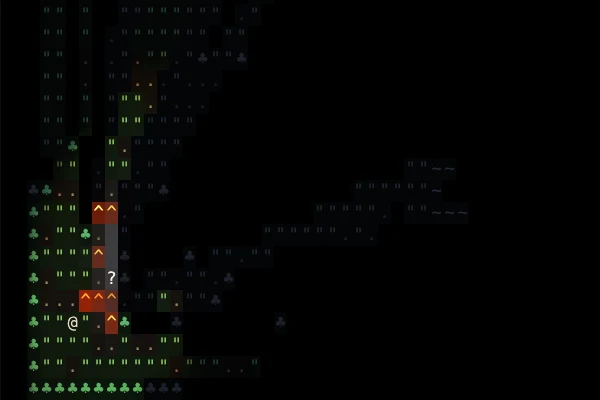
  • Creatures see and chase you through portals and around mirrors by the same rules you do.
Night in a grassy field. Beside the player, a violet portal shows a patch of river and a stranger far across the map.

First light

The first playable build: a night on the proving ground, a torch, and a world that follows its own rules.

  • A simulation where fire spreads through dry grass, water puts it out, oil burns and floats, and lightning runs through anything wet.
  • One light for the whole world. What it doesn't reach is black, and what you've seen stays on the map as a memory.
  • Fire, oil and lightning to throw, wolves that are afraid of fire, and stairs down into the dark.
  • Every run comes from a seed, so the same choices always play out the same way.
Fire burning in red and orange through dry grass at night, a few cells from the player.